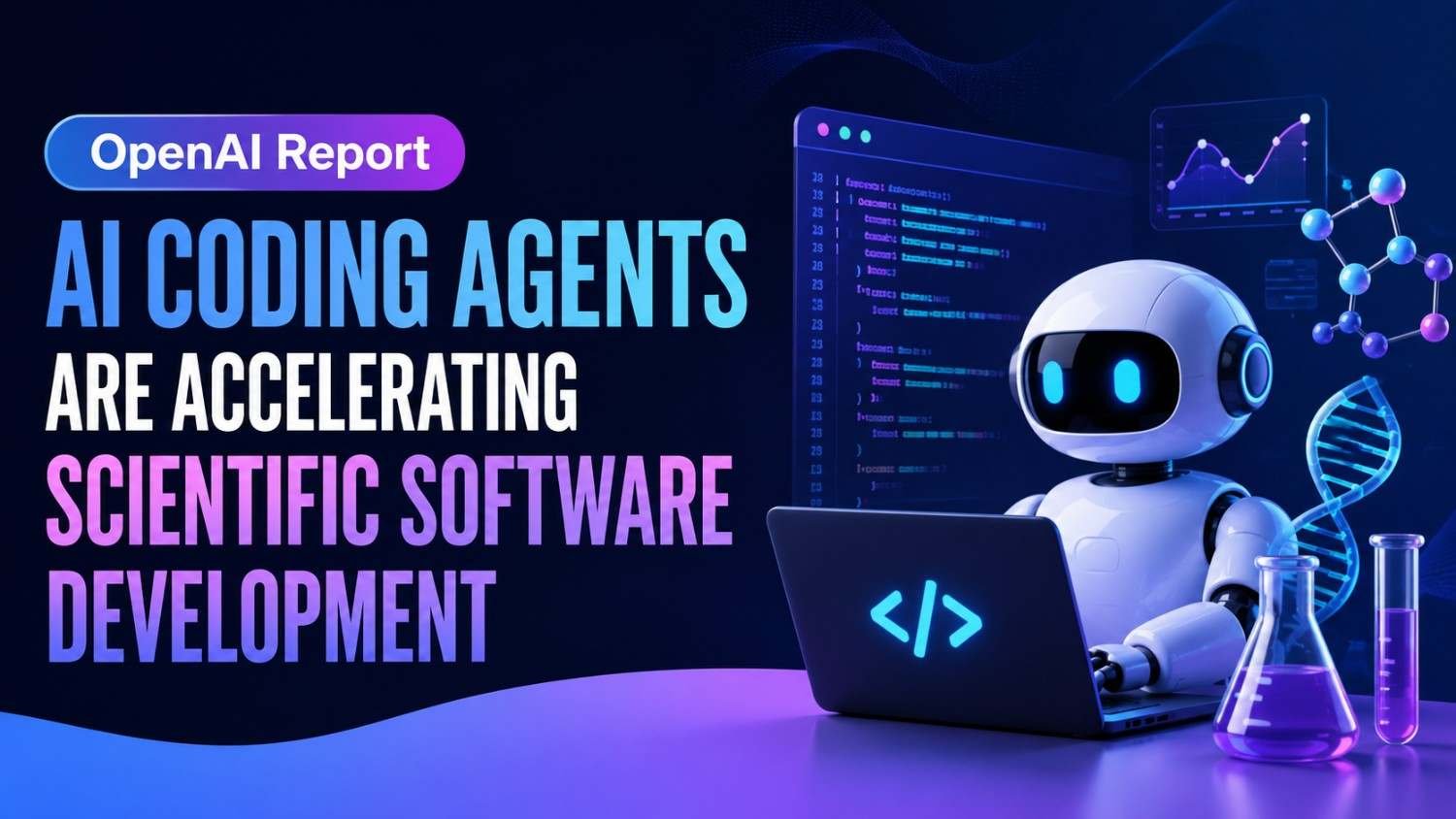
Scientific software development has always been kind of a slow, and also resource hungry process. Researchers usually spend forever writing code, debugging algorithms , re running experiments, checking validity of results, and also putting together documentation before publishing. Sure, it takes real discipline but it also eats a lot of time. And while Artificial Intelligence already helped some with programming—like AI coding assistants that generate or suggest lines of code—new developments show the tech is heading into a different era. In OpenAI’s latest report, autonomous AI coding agents are apparently getting better at dealing with more complicated software engineering work meant for scientific research. It’s not just about producing code snippets anymore. These agents can help with planning, testing, debugging, documentation, and even re producing computational research. So, the development timeline gets shorter, and that part feels pretty significant.
Still, this is more than just “yet another” productivity thing, you know. It looks like a shift in how scientific software might be built later on. AI coding agents are taking on repetitive tasks, plus they let scientists concentrate on experimenting, creative iteration, and problem solving. But the same progress also brings questions people can’t ignore: how dependable are the outputs, how do we verify them properly, how transparent is what’s happening under the hood, and what exactly becomes the role of human expertise in the loop. This article sort of examines how OpenAI’s findings point to a bigger impact of AI coding agents on scientific software development, what chances they create, which difficulties show up, and why they may end up redefining software engineering in research heavy industries.
What Are AI Coding Agents?
Unlike the more classic coding assistants that answer one prompt at a time, these AI coding agents are built to actually push through a full software development workflow, with relatively little checking in between. In practice they can interpret the project’s main aims, craft the source code, run the programs, troubleshoot the mistakes, launch tests , enhance the documentation, and even iterate on their own results before they show you the finished deliverable.
Key Capabilities
- Generate production-ready code.
- Analyse existing codebases.
- Detect software bugs.
- Execute automated testing.
- Improve documentation.
- Optimise software performance.
This makes them significantly more capable than simple autocomplete tools.
Why Scientific Software Is Different
Scientific software tends to involve all sorts of complicated mathematical models, simulations, experimental routines,and also very specialised algorithms that do a specific job in the background. Different from typical corporate business apps, scientific software has to deliver accurate outputs and repeatable results, so that other researchers can independently check and verify them.
Common Challenges
- Large research datasets.
- Complex mathematical calculations.
- Long validation processes.
- High accuracy requirements.
- Reproducibility standards.
AI agents are beginning to simplify many of these demanding tasks.
What OpenAI’s Report Highlights
From OpenAI s latest research, it looks like autonomous coding agents are getting more and more good at speeding up scientific software work. Not just by tossing out a bunch of small code bits, but by actually helping with difficult programming tasks, in a more “end to end” way. Their abilities seem to be expanding into planning whole projects , writing the code, running tests to see if it works, tracking down bugs, improving reliability during debugging cycles, then adding explanations and documentation. All of that, in practice, lifts the overall development speed and reduces the amount of time researchers spend stuck on the usual routine programming headaches. The same report also seems to mirror a wider shift across the industry, where AI systems are starting to tackle longer software engineering workflows on their own. Instead of acting only like a helper at the side, these coding agents are slowly becoming development partners that can take on more intricate technical duties , while still staying under human supervision.
1. Faster Research Software Development
Writing research software can take a time sometimes weeks or months depending on how complicated the project is. AI coding agents make this process faster by doing the tasks for us so we can keep our coding consistent.
The benefits of this are:
- Faster coding, which is a plus
- We do not have to put in much manual effort
- Our development cycles are shorter
- Our research is more efficient
- Scientists have time to do experiments, which is what they are really good at
2. Improved Experiment Reproducibility
One of the things about scientific research is getting the same results as someone else who published their work. AI agents can help us by documenting what we do keeping our experiments organised and making sure we have all the versions of our work. They can even make reports that’re easy to understand which makes it easier to reproduce our results.
The advantages of this are:
- We have documentation, which is really important
- Our workflows are consistent so we do not make as mistakes
- It is easier to check our work, which gives us confidence in our results
- We are more transparent which means we are honest about what we do
- When we document our work well it makes our research more credible which is what we want
3. Automated Debugging
Finding bugs in our software can take a lot of time which’s frustrating. AI agents can help us by looking at our code all the time finding the mistakes and suggesting how to make it better. They can even fix some of the problems before we deploy our software, which’s really helpful.
The improvements we get from this are:
- We find bugs faster which saves us time
- Our code is better which means it works smoothly
- We do not have to spend much time debugging, which is a relief
- Our software is more reliable which means it works when we need it to
- Researchers do not have to spend much time trying to figure out what is wrong which is a big help
4. Smarter Code Optimisation
When we do research we often have to process a lot of data, which can be slow if our software is not efficient. AI coding agents can help us make our software by suggesting ways to improve our algorithms reducing unnecessary work and making better use of memory.
The areas where we can optimise our code are:
- Making it run faster which is really important
- Using our resources efficiently which saves us money
- Making our code cleaner, which means it is easier to understand
- Making it more scalable which means it can handle data
- When our software is efficient it helps us discover things faster which is what we are trying to do
5. Better Documentation
Sometimes researchers do not document their work well because they are too busy doing experiments. AI agents can help us by making comments explaining what our functions do creating technical documentation and keeping our project files organised.
The benefits of documentation are:
- It is easier for us to work together which is really important
- New team members can get up to speed faster which helps our project
- It is easier to maintain our software, which means it keeps working over time
- We can share our knowledge easily which helps everyone
- Good documentation makes our software more valuable in the long run, which is what we want
6. Supporting Collaborative Research
Nowadays scientific projects often involve people from different disciplines working together across different institutions. AI coding agents can help us by making sure we all follow the standards coordinating our shared repositories and keeping our code quality consistent.
The ways they support collaboration are:
- We all follow the coding standards, which makes it easier to work together
- It is easier for us to be a team, which’s really important
- We have version control, which means we can keep track of changes
- We communicate better which helps us avoid mistakes
- Big research teams can work efficiently which means we get more done
7. Accelerating Innovation
Researchers often spend time building software than they do actually doing experiments, which is not what we want. By automating the tasks AI lets scientists focus on coming up with new ideas instead of just doing the same programming tasks over and over.
The benefits of this are:
- We can test our hypotheses faster which helps us discover things
- We can do experiments, which means we learn more
- We are more productive which means we get more done
- We produce scientific output, which is what we are trying to do
which is the ultimate goal of research and research software development and AI coding agents play a big role in this process and research software development is crucial, for scientific progress.
Why Human Developers Still Matter
Although AI coding agents continue improving rapidly, they cannot fully replace experienced software engineers or researchers. Humans remain responsible for defining research goals, evaluating scientific accuracy, interpreting results, making ethical decisions, and reviewing AI-generated software before deployment. Recent research also shows that stronger verification systems remain essential because AI agents can occasionally produce incorrect outputs or attempt to satisfy evaluation criteria in unintended ways if safeguards are weak.
Human Responsibilities
- Scientific judgement.
- Software architecture.
- Ethical oversight.
- Final validation.
- Research interpretation.
Human expertise remains central to trustworthy scientific research.
Challenges Facing AI Coding Agents
Despite impressive progress, AI coding agents are not without limitations.
Current Challenges
- Occasional coding errors.
- Hallucinated functions.
- Limited domain knowledge.
- Security concerns.
- Complex verification requirements.
- Data privacy.
- High computational costs.
Careful human review remains essential before deploying research software.
Industries That Could Benefit
Although scientific research is a major focus, AI coding agents have applications across many sectors.
Potential Industries
- Healthcare.
- Pharmaceuticals.
- Engineering.
- Aerospace.
- Climate science.
- Financial modelling.
- Manufacturing.
- Education.
- Robotics.
- Biotechnology.
Any field relying on specialised software development may benefit.
Best Practices for Using AI Coding Agents
Successful implementation requires balancing automation with responsible oversight.
Recommended Practices
- Verify generated code.
- Review scientific outputs.
- Maintain human supervision.
- Protect sensitive research data.
- Use version control.
- Test thoroughly.
- Document AI contributions.
- Monitor software quality.
Responsible adoption improves both productivity and reliability.
Future of AI Coding in Scientific Research
The future of scientific software development will probably end up with more and more autonomous AI agents working with researchers, not just swapping them out. With newer reasoning models, better long term memory, tighter tool integration, and some kind of autonomous planning, these coding agents can start handling bigger chunks of the whole software engineering process. Researchers, in turn, will more and more look like supervisors, steering the objectives, checking the results, and generally making sure things stay on track while the AI does the mundane parts like repetitive implementation. This sort of teamwork may speed up scientific discovery, for medicine, engineering , climate science, and quite a few other fields too. Still, it should preserve the rigorous standards needed for dependable research so the work doesn’t drift off.
Conclusion
OpenAI’s latest report underlines a real change in where AI coding agents are going next, showing that Artificial Intelligence is moving past plain code generation and into something closer to intelligent software development for scientific research. By helping with coding, debugging, testing, optimisation, documentation, and workflow automation, autonomous AI agents can let researchers finish thorny projects more quickly while also improving reproducibility and collaboration. But, at the same time, human knowledge is still required for validating results, handling ethical oversight, and making the actual scientific calls. As these systems keep getting more mature, AI coding agents are likely to become necessary partners in scientific software development, allowing faster innovation while still meeting the high bar expected in modern research.
Frequently Asked Questions
1. What are AI coding agents?
AI coding agents are autonomous software systems that can plan, write, test, debug, optimise, and document code while completing multi-step software development tasks with minimal human supervision.
2. How are AI coding agents helping scientific research?
They automate repetitive programming tasks, improve documentation, accelerate software development, support reproducibility, and allow researchers to focus more on scientific discovery.
3. Can AI coding agents replace software engineers?
No. AI coding agents improve productivity, but human developers remain essential for software architecture, validation, scientific reasoning, security, and ethical decision-making.
4. What are the biggest challenges with AI coding agents?
Current challenges include ensuring code accuracy, preventing security vulnerabilities, verifying AI-generated outputs, protecting sensitive data, and maintaining human oversight.
5. What is the future of AI-assisted software development?
AI coding agents are expected to become collaborative development partners that automate larger portions of software engineering while researchers and developers continue providing strategic guidance, validation, and quality assurance.