AI is no longer just a lab idea. It is showing up in daily routines and reshaping work, school, messages, shopping, art, and how people decide things. At the same time, not everyone is cheering. Some younger adults are starting to doubt the leaders behind the AI push. This worry is not only about whether the tools function. It is about trust. It is also about career risk, and about whether the rollout is being handled with care.
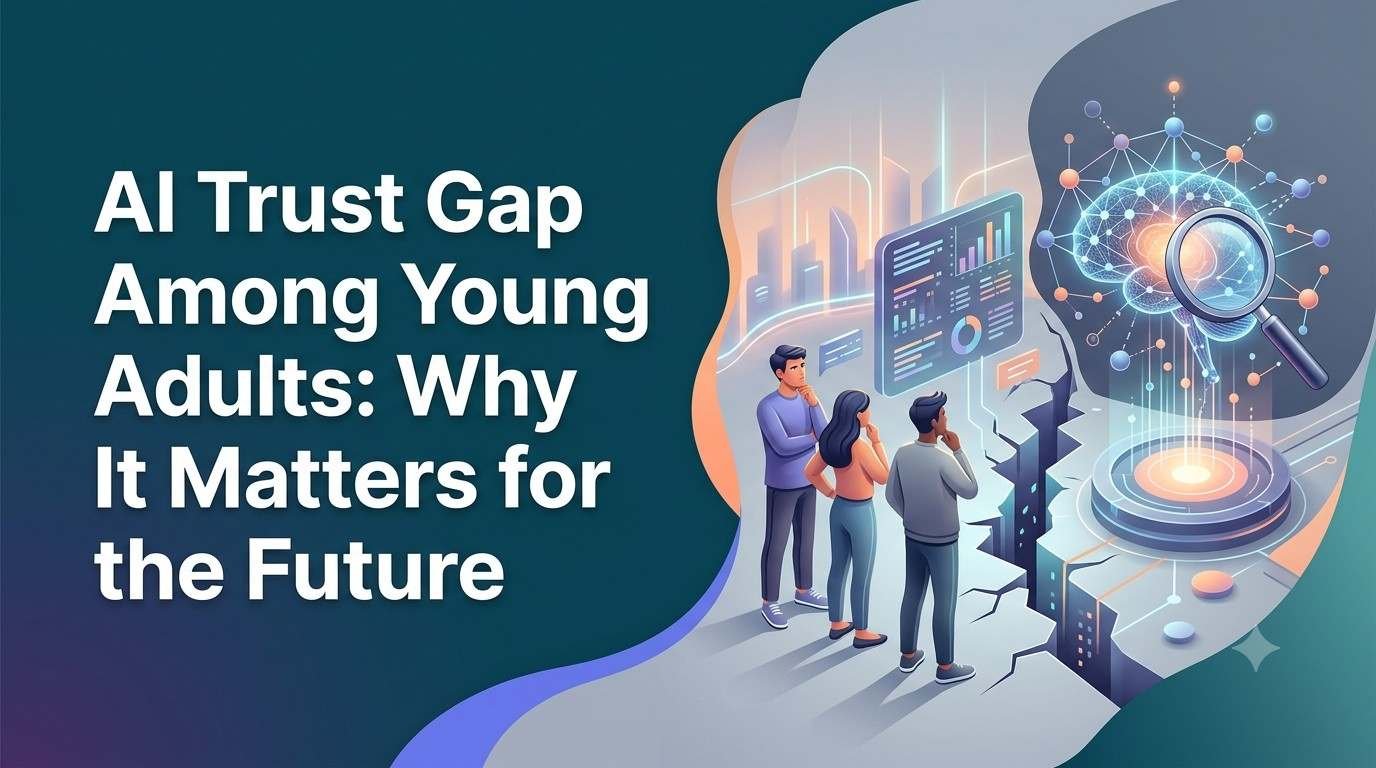
This “trust gap” could turn into a real business problem. A CNBC and Generation Lab poll surveyed 1,088 Americans from ages 18 to 34. Many of them said they do not trust several well known AI and tech figures. The survey also showed that 45% think AI will hurt their careers. Forty percent backed strong government rules. Sixty percent said the tech sector should slow down building data centers. Taken together, these views point to one key issue. AI progress may not be enough. Companies may need to earn public confidence as they expand.
What the AI trust gap means
The AI trust gap is the gap between what tech leaders expect from AI and what regular people feel. Executives tend to stress gains like higher output, fresh products, help with routine tasks, and more economic activity. Younger adults may judge the same tools in a different way. They may ask whether AI will replace entry-level jobs, reduce opportunities for graduates, compromise privacy, increase inequality, or give large technology companies too much influence. This does not mean young adults are necessarily anti-AI. Rather, it suggests that enthusiasm for the technology can exist alongside concerns about how it is developed and deployed.
Why Are Young Adults Concerned About AI?
Young adults are stepping into work that is shifting fast. Many students and people new to jobs spent years building skills, only to find that AI can now help with, or even take over, parts of what they do.
A TechNewsWorld piece says 45% of people in the survey thought AI would harm their careers. That fear makes sense. Early roles are where people usually learn by doing, meet others in the field, and figure out how workplaces really run. If AI changes how people enter those roles, it is natural for young workers to ask what their first step will be.
AI and job change
A major piece of public trust is how AI shows up at work. AI can handle repeat tasks, pull together summaries, create drafts, sort and read data, and assist with choices. These tools may raise output. Still, workers might feel that bosses will use AI to cut staff instead of making work easier.
So it matters whether AI is meant to remove people or to support them. Firms that show, in clear ways, how AI can help staff take on tasks with more value may earn more trust than firms that lean only on broad claims about automation and savings.
A trust issue for AI leaders
People often link trust in tech to the leaders behind it. TechNewsWorld cites a CNBC and Generation Lab poll. In that poll, distrust was high for several well known tech figures. Alex Karp had an 81% distrust score. Peter Thiel was at 79%. Mark Zuckerberg had 71%. Elon Musk had 70%. Sam Altman had 69%. . Microsoft CEO Satya Nadella performed better, although only 35% of respondents said they trusted him.
You should not treat these numbers as a direct verdict on how good the leaders’ firms or products are. Still, the figures point to a trust issue that AI companies keep running into. If people do not trust the people in charge, then even fair claims about what AI can do may get pushback.
Why people care about openness
One step toward better trust is more openness from the company. Many people want to see how an AI tool affects them. If a system is used in hiring, loan decisions, customer support, school settings, or other big choices, users may ask what inputs are used and what limits are in place.
Openness does not mean handing over every technical detail of a private model. It means stating what the tool is for, what it cannot do, what risks exist, how data is handled, what human checks exist, and where the tool should be used. Short, plain explanations often help more than heavy technical promises.
How privacy ties to trust
Data is a core part of modern AI. In real use, models and apps can work with a lot of information, so privacy is tied to public confidence. Even if younger adults are used to online services, they may still wonder what happens to their data after it is gathered. They may want straight answers on whether personal data is saved, sent to others, used for training, or kept forever.
Firms can build trust by laying out their data practices in a clear way. They can also cut back on data they do not need, offer controls that actually help, and describe security steps in words that regular people understand.
Why AI Regulation Is Becoming Part of the Conversation
The TechNewsWorld piece points to a survey where 40% of people said they want strong government control over AI. This result fits a wider fight over how AI should be governed. Those who back stricter rules often say it helps keep consumers safe. They also mention worker protection, privacy, and public safety. Those who oppose heavy rules sometimes argue it could slow progress. They may also say it can make it tough for small firms to compete.
The tough part is drawing boundaries for real harm while still leaving room for new uses. For tech firms, trust may hold up better when they show up in rule talks early. It helps more than treating any oversight as if it is automatically hostile.
AI infrastructure adds a second kind of trust issue
AI is not only software. Major systems depend on real sites, like data centers and server rooms. They also rely on power grids, cooling units, and other physical support. The TechNewsWorld report says that in the same survey, 60% wanted companies to slow down new data center projects.
That stance matters for nearby areas. Bigger sites can change how much power is used. They can also affect water needs, traffic, local construction work, and environmental outcomes. They may also shift how money is spent on roads and other services. As more AI sites come online, companies will likely need ongoing dialogue with local residents. They cannot just announce plans and assume approval.
The environmental angle also plays in
AI can influence public views in another way tied to the environment. Training and running large AI tools need major computing power. That power takes energy. Data centers may also need cooling, which depends on how they are built and where they are placed.
Technology firms can respond to worries in clear ways. They can cut energy use, put money into the right systems, share what they need to run services, and spell out the likely gains for the economy and society. This is not about pretending AI has no footprint. A better route is to be upfront about trade-offs and show what is being done to keep them in check.
The hiring issue for AI firms
AI work relies on trained people in many roles. Engineers, researchers, builders, security staff, product managers, and similar teams all matter. Because of that, hiring for AI is also a trust topic.
If early career talent thinks a company is building tools in a way that clashes with their beliefs, they may go elsewhere. Pay can steer choices, but it rarely acts alone. People also look at how the company is seen in public, the mission, day to day culture, chances to learn, and what workers feel about the wider effect of the work. Even if a firm is well known for strong tech skills, a weaker public image can make hiring harder over time.
Young workers want more than a promise
Tech companies often say that AI will open doors. Still, many younger workers ask for proof, not forecasts. Rather than claiming that AI boosts output in general, a firm can show what changes in real jobs. They can explain how staff use AI to drop repeated tasks and then spend more time on design, planning, or other higher value work.
This is where careful AI use matters. Workers should get training, simple rules, real people who review work, and chances to learn skills that fit the job. When a firm can point to clear results, it is easier to drop vague claims and show real proof.
AI Should Support People When It Fits
One way to rebuild trust is to focus on people working with AI. AI can take on tasks that are routine or that pull together lots of info. Humans still lead on judgment, trust with others, new ideas, values, and tough decisions.
Look at customer support. AI may summarize past chats or draft a reply. Staff members then handle the hard cases or anything that feels risky. With this setup, AI acts like a helper, not a full swap. That can also shape how workers feel about the tools.
How Firms Can Rebuild Trust In AI
Fixing trust is not only about press releases. A company has to show it acts in a careful way. This comes through the product itself, how people are treated at work, the systems behind the scenes, and the messages it shares.
A practical trust-building approach includes:
- Explain what AI systems actually do.
- Be honest about limitations.
- Provide meaningful human oversight.
- Protect user data.
- Give employees AI training.
- Communicate job impacts realistically.
- Engage local communities around infrastructure.
- Publish evidence of benefits.
- Address failures openly.
- Participate constructively in policy discussions.
Trust develops when actions repeatedly support the messages a company communicates.
Why AI Communication Needs to Change
Tech firms often talk about AI by pointing to technical wins. They cite bigger models, quicker inference, more compute, higher benchmark scores, and added features. For engineers, that kind of update is useful. For everyday people, the questions can be different.
They want to know:
Will this make my work easier?
Will my job still exist?
Is my information safe?
Can I challenge an AI decision?
Who is accountable when something goes wrong?
These questions should feed into an AI communication plan. If you talk about what the tool can do but ignore what worries people, you will likely lose part of the audience.
Building credibility with proof
Trust tends to grow when a firm shows outcomes instead of only forecasts. If AI helps staff work faster, share numbers. If an AI feature cuts customer waiting time, show that change. If a company says AI will lead to new roles, describe those roles. Also explain how people will learn for them.
This way of talking helps with accountability. People can check whether the results match the promises. It also pushes companies to be more careful about the gains they suggest.
Education and AI literacy
Some fear about AI comes from not knowing. Many people hear mixed messages about what AI can handle. That makes it hard to tell real limits from inflated claims. Training on AI can reduce that confusion.
Schools, colleges, workplaces, and tech firms can teach people how these systems behave in day to day use. They can cover where AI works, where it breaks, and how to judge what it produces. Even with better knowledge, trust does not rise automatically. Still, people who understand the basics can choose with more care. They are less likely to react to fear or hype.
AI Trust Is Also a Business Issue
Trust affects what people buy, whether they adopt new tools, who applies for jobs, how rules get set, and how the public views a company. In a TechNewsWorld analysis, the concern is that young adults who stay distrustful may later slow down AI take up, job hiring tied to AI, work on new systems, and public policy.
Because of that, an AI plan should not stop at building a product. Firms have to look at how choices land on different groups. That includes staff, buyers, local communities, regulators, and people who will enter the labor market later. Even a strong technical product can fall short if the public does not feel safe about the company making it.
What companies can learn about a trust gap
If a firm brings in AI, it should not assume people will be happy right away. Leaders should talk before rollout. They should say why the tools are coming, what will change in daily work, what will stay the same, and how results will be judged. People tend to act more carefully when they know both the benefits and the limits.
Firms should also set clear guidance for private data, human checks, allowed uses, and who is responsible when things go wrong. This is a key piece of trust in enterprise AI. When staff can see the rules, they are more likely to use the system in a proper way.
What the AI field should do next
The AI sector can start treating public trust as a real score, not just a message. That could mean tracking how employees feel, how confident customers are, how well adoption goes, what complaints show up, privacy problems, system mistakes, and concerns raised by communities. Those measures can sit next to the usual business numbers.
It also means admitting that some worries will not fade through ads or press releases. A few issues will need changes to product features, written policies, planning for the tools and systems, or how the organization behaves day to day .
The Long-Term Cost of Losing Trust
The real risk in an AI trust problem is not that people will quit using tools right away. A more common outcome is that uptake slows down. People may push back more. Rules may tighten. Hiring gets tougher. Reviews become more intense.
Many younger adults will move into decision roles later. They will lead teams. They will run firms. They will choose vendors. They will write policies. They will invest. What they think about AI now can steer the field for a long time. If companies earn trust early, they may lay a base for later growth. If they dismiss doubts, it can take more time and more money to undo that damage.
The Future of AI Trust
Trust in AI will hinge on whether the gains are seen in real life and reached by more people. The tech does not have to work well for every person in every case to win confidence. Still, people will want to see that firms take the downsides seriously. They also need to know who gets the upside.
The TechNewsWorld piece frames its polling as a caution, not as final proof that adoption will fail. It also says that views may shift as the tools mature and as results become easier to see. That creates a key opening for the industry. Show the value in practice. Do not only make claims.
Conclusion
Young adults are losing trust in AI. That matters for the whole tech business. It should not be treated like a short-lived argument about a new tool. A TechNewsWorld poll points to clear distrust of several well known tech leaders. It also shows worry about what AI could do to careers. People also want tighter rules. They are concerned about how data centers will expand. Fixing this will not come from catchy lines or cheerful forecasts. Firms have to show that they can use AI in a careful way. They should talk openly about what they do. They need better privacy steps. Staff also need real training, not just a slide deck. There must be real human review when it counts. Companies should reach out to local communities. They should also share proof that AI brings real benefit to daily life. If the industry links new tech to practical gains for workers, better service for customers, and safer outcomes for communities, trust can turn into an advantage. Otherwise, the problem will keep growing.
Frequently Asked Questions
1. What is the AI trust gap?
The AI trust gap refers to the difference between the confidence technology leaders have in AI and the skepticism or concerns expressed by parts of the public, including younger adults.
2. Why do young adults distrust AI?
Concerns include potential job disruption, privacy, corporate power, AI errors, regulation, and uncertainty about how artificial intelligence will affect early-career opportunities.
3. How can companies build trust in AI?
Companies can improve trust through transparency, responsible data practices, employee training, human oversight, clear communication, measurable benefits, and accountability for AI-related failures.
4. Will AI replace jobs for young workers?
AI may automate some tasks and change many jobs, but its overall impact will vary by industry and occupation. Businesses can reduce disruption by using AI to augment employees and provide opportunities for reskilling.
5. Why do AI data centers affect public trust?
Large data centers can raise questions about electricity, water, infrastructure, environmental impact, and local economic benefits. Addressing these concerns openly can help technology companies build stronger community relationships.