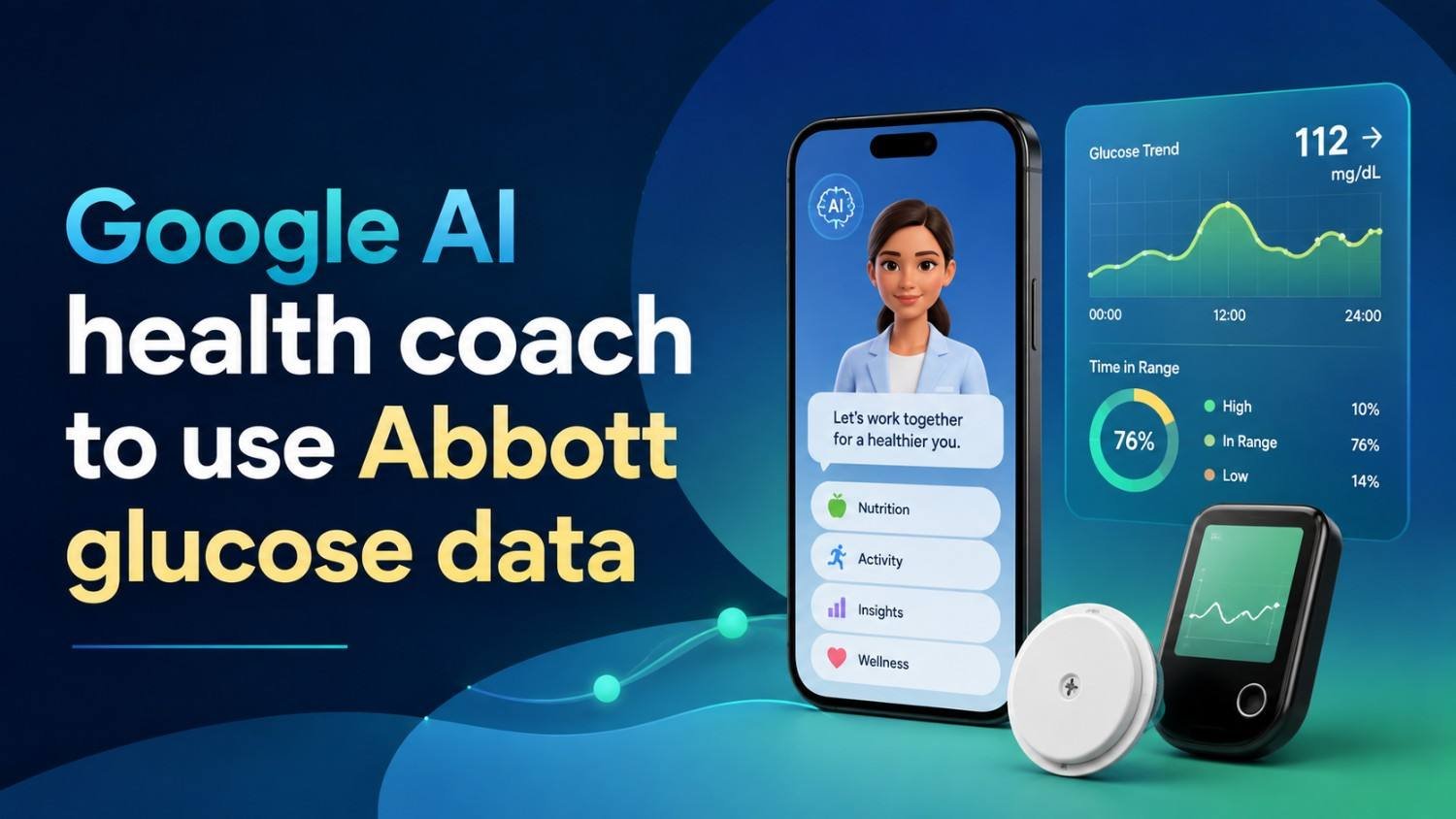
Imagine wearing a tiny glucose sensor and then seeing not just your glucose trends , but also how your meals, exercise, sleep and day to day routines might connect to those shifts. Kinda like, “oh… that explains it”. Now picture an AI system combing through that information along with other health and wellness signals, and then turning it into tailored recommendations. That whole concept is what sits behind a new multi-year collaboration between Abbott and Google Health, which they announced on August 11 , 2026. For years, health technology has been producing huge amounts of personal data. But, honestly, making sense of what it all means has still been hard for regular users. A wearable can show numbers, graphs, and trends, sure. Yet most people still end up figuring it out themselves, or they just don’t. The Abbott and Google partnership wants to bridge that annoying gap, by mixing Abbott’s Lingo glucose insights with Google’s AI powered Health Coach.
They say the integration should start rolling out later in 2026, though the companies also stress that it’s meant as support for health and wellness, not a clinical diagnosis thing. Basically guidance, not medical verdicts. Throughout the story, you’ll see phrases like AI health coach, glucose monitoring, personalized health insights, AI in healthcare, and metabolic health show up in a natural way. And it also folds in longer search type ideas like Google Health Coach glucose data , Abbott Lingo AI health integration , AI-powered metabolic health, glucose tracking for wellness, personalized health coaching with AI, continuous glucose monitoring for non-diabetics, future of AI health technology, AI wellness recommendations, consumer health wearables, and how AI uses health data.
What Is the Google and Abbott Partnership?
The partnership brings together Abbott’s Lingo biowearable technology and Google’s consumer health, and artificial intelligence capabilities. Lingo is an over-the-counter continuous glucose monitoring system that is made for adults, age 18 and older who are not using insulin. It gives ongoing glucose information meant to help people understand how things like food, physical activity, sleep, and stress can impact their glucose patterns, and maybe make them more aware over time.
Under the collaboration, Lingo users will eventually be able to see their glucose trends alongside other health and wellness bits within the Google Health app. Then Google’s Health Coach can lean on those insights to deliver contextual recommendations tied to nutrition, activity, sleep, and recovery. So, in a way, this is a meaningful turn away from just monitoring glucose, toward interpreting health information in context, not only checking numbers.
How Could AI Health Coaching Work?
Traditional health tracking usually makes people sort through a bunch of different dashboards, kind of on their own. Like one app shows sleep, another one talks about activity, then nutrition in a separate place, and a glucose sensor gives yet another collection of trends. In theory, an AI health coach could link those pieces up and sort of help someone see how they relate, not just list numbers. Instead of only throwing a glucose reading at you, the system could use the wider context it already has access to and then suggest personalized wellness guidance.
For instance, a person might notice that certain meals, shifts in physical activity, or even small variations in sleep line up with specific glucose patterns. Then the AI can help put those observations into something clearer, instead of leaving the user staring at disconnected charts that don’t really connect. The companies say the intention is to help people form durable habits around nutrition, movement, sleep, and recovery, all together, not as separate little islands.
Why Glucose Data Matters Beyond Diabetes
Glucose is pretty tightly tied to how the body handles energy, and glucose patterns can get nudged around by those everyday things like food, moving your body, sleep, and even stress. That said, it still doesn’t mean that every little glucose swing is automatically a health problem. More continuous readings can instead give extra signals about how someone responds to real life behaviors, kind of like a mirror. Abbott places Lingo as a wellness oriented tool for adults who are not on insulin , not as some stand in for clinical diabetes care. The company basically says the device aims to help users see the impact of lifestyle choices and then make better decisions. This line matters, because glucose tracking for wellness should not be mixed up with medical diagnosis or any actual treatment plan.
From Health Data to Personalized Health Insights
The biggest upside of this partnership is not just grabbing more information. It is about making it easier to grasp. A lot of people already have smartwatches, activity trackers, sleep monitors, or other connected gadgets. The tricky part is that more data does not automatically turn into better choices.
Personalized health insights, in other words, come from context. Rather than asking users to figure out dozens of separate numbers alone, an AI system could spot trends and explain them in simpler terms. The companies describe this as building a fuller snapshot of personal health, by blending glucose information with other wellness metrics and not treating it like an isolated reading.
How Google Health Coach Could Use Glucose Information
The Google Health Coach is expected to use Lingo insights to provide recommendations around several areas of daily life. According to the companies, those areas include nutrition, physical activity, sleep, and recovery.
The concept can be understood as a continuous feedback loop:
- A wearable collects health-related information.
- The information is organized within the health platform.
- AI identifies potentially relevant patterns.
- The system provides contextual suggestions.
- Users decide which changes are practical for them.
- Future data can show how those changes relate to subsequent trends.
This is one reason AI in healthcare is increasingly moving beyond hospital environments and into consumer wellness technology.
Why This Is Different From a Basic Fitness Tracker
A traditional fitness tracker might tell you, how many steps you walked, or how long you slept, know. But a glucose sensor adds another layer of information, almost like it is zooming in a bit. It can show glucose changes over time and how those shifts line up with everyday behavior. The Google- Abbott approach tries to connect these different streams of data, instead of treating each metric like a stand alone number. If it works as intended , consumer health wearables could become more practical for people who are trying to actually understand their daily habits. So rather than staring at one measurement at a time, the focus leans into the links between what you do and what your body responds back with.
The Role of AI in Everyday Health Decisions
Artificial intelligence can be especially useful when lots of information has to be organized fast. Health and wellness data gets complicated, because measurements shift throughout the day and also get pushed around by a bunch of factors. An AI system might help sort patterns and turn them into something that feels more understandable. Still, the value of an AI suggestion really depends on the quality of the underlying information, plus the way the system is built, and what context it can access. That means AI-driven metabolic health tools should be seen as decision-support and educational aids, not as unquestionable authorities.
A Major Metabolic Health Research Opportunity
The partnership is not limited to consumer features. Abbott and Google also said they have plans for a big real-world metabolic health study. The research is expected to mix continuous glucose readings with wearable information, lab details, and survey responses. The goal is to look at how activity, sleep, well-being, and metabolic health connect together, more or less over time. This could end up being one of the most important parts of the collaboration, because massive datasets gathered in the real world might help researchers see how daily habits interact, sorta, as time goes by. The companies claim the results could support future AI coaching abilities and future Lingo product features.
Why real-world health data matters
Clinical studies are key, but everyday behavior is kind of hard to catch inside tightly controlled environments. People eat different foods, sleep at different hours exercise inconsistently, deal with different stress levels and live in really different lifestyles. Real-world data can, in theory, give a more nuanced view of those differences.
When continuous glucose information is paired with wearable, laboratory, and survey data, researchers may be able to examine patterns that would be difficult to figure out from just one single source. That might steer the wider future of AI-based health technology, overall.
The Importance of Personalized Recommendations
Generic health guidance is pretty easy to find, like really. The harder part is figuring out how that guidance actually fits to one person real life situation. Example, telling everyone to “ sleep better” is straightforward. But helping someone connect their sleep timing and patterns to what they are doing day to day, and even to other wellness measurements , that feels more helpful, in a practical sense.
This is where personalized health coaching with AI could end up being valuable. Instead of throwing a generic checklist at people, an AI system can potentially look at a person own data and then give suggestions that feel more relevant. Still, any suggestions have to be interpreted carefully, because human health is complicated , and a correlation does not always mean causation. Like it might just be related, not necessarily the reason.
Could AI Replace Doctors?
No. This is one of the key things to keep straight. Google explicitly says that Health Coach is not meant for medical purposes and it tells users to verify the answers for accuracy. Abbott also describes Lingo as a wellness-focused product rather than a diagnostic instrument for diseases like diabetes.
An AI wellness setup can help arrange information, nudge better habits, and make the numbers easier to read. But it should not replace trained medical professionals when someone has symptoms, an established diagnosis, abnormal test results, or worries about treatment. The safest job for consumer AI is to support informed choices, not make medical decisions on its own.
Privacy Will Be a Major Consideration
Health data is kinda , honestly, very personal. When platforms start bringing together glucose readings, wearable measurements, activity patterns, sleep signals lifestyle details and maybe other health metrics, privacy becomes more and more of an issue, like it really does. People should try to know what exact info is gathered, where it is stored, what services can reach it, and what it might be used for later. The announcement leans a lot on what the integration can do. But consumers still ought to look through the privacy policies and the permissions involved before they connect health devices to digital platforms. If someone is trying to figure out how AI uses health data, clarity should matter just as much as convenience, if not more.
The Accuracy Challenge
AI generated health guidance brings up another worry, which is accuracy. AI systems might give incorrect guidance or just inappropriate answers in general. Google’s own announcement even says pretty directly that Health Coach isn’t meant for medical purposes, and it tells users to verify what it says for accuracy. So users shouldn’t simply assume every suggestion is safe or correct. A solid way to think about it is to use AI guidance as one source of information, not the only one. For big, meaningful health decisions professional medical advice is still usually the better fit.
What This Means for the Future of Wearable Technology
The partnership basically shows a bigger shift in wearable technology . Back when fitness trackers first became common they mostly did simple stuff, like steps, heart rate , and how long you were moving. Now the newer gadgets are picking up more granular physiological information ,and that changes everything a bit.
Next, maybe the real move is turning those measurements into more tailored guidance. In other words, the future of wearables could be less about flashing numbers all day and more about helping people make sense of what those numbers might mean in regular life ,not just in a lab.
Could This Make Preventive Health More Accessible?
One of the strongest reasons people give for consumer health tech is that it can push folks to notice their habits before things get worse. Abbott and Google say their cooperation is meant to help people connect daily routines with overall wellbeing and enable more early, proactive choices.
Still, preventive health tech should add to —not swap out— regular medical care. A wearable doesn’t give the full story about someone’s health. Things like genetics, medical history, medications, surroundings, socioeconomic realities, and a bunch of other variables also count, even if you can’t see them on your wrist.
What Users Should Watch For
As the integration slowly comes in, consumers should look at a few real-world points. The firms say the Lingo integrations are expected to start rolling out in the Google Health app sometime later in 2026 . Google Health Coach also needs a Google Health Premium subscription, the Google Health app, and a working internet connection, with availability depending on device type and local market .
Users should therefore consider:
- Whether the feature is available in their region.
- Which devices are supported.
- What subscription is required.
- What data is being shared.
- What the AI recommendations are actually intended to do.
- Whether a recommendation requires professional medical confirmation.
These questions can help consumers separate useful technology from marketing hype.
The Bigger Trend: AI Is Becoming a Health Interface
The Google-Abbott partnership seems to mean more than a shiny new wearable integration. It kind of shows how AI might keep getting used as the interface, the thing people rely on, for dealing with complicated personal data. Instead of opening a few apps at once, and then staring at separate charts, people may ask an AI system questions about their health info and get explanations that are stitched together from connected data . That would make digital health feel more reachable, though, and it also boosts the need for accuracy, privacy, transparency, and careful product design.
What could come next?
The partnership’s research part could end up being especially important. If the bigger scale study turns out useful evidence about how glucose, sleep, physical activity, well-being, and other things link together, then those insights could shape future coaching systems and even update what wearable features do. Over time, the direction might move toward more merged health platforms that pool information from several sensors, and then use AI so people can actually make sense of recurring patterns . The real test, though , will be whether these systems give guidance that is genuinely helpful, not just producing extra alerts, every single day.
Conclusion
The Abbott and Google partnership feels like a pretty interesting turn in how consumer health technology is evolving. By linking Abbott’s Lingo continuous glucose monitoring with Google’s Health Coach, they want to get past just collecting numbers and instead offer more personalized health insights , kinda tying together glucose trends with nutrition, movement, sleep, and recovery. There’s also this planned real-world metabolic health study, which could end up giving solid evidence for what future AI based wellness tools can actually do in practice. Still, users might want to keep some realism in mind because none of this is magic: Google notes Health Coach is not intended for medical purposes, AI answers should be double checked for accuracy, and health data privacy really needs careful attention. If this is rolled out in a responsible way, wearable sensors plus AI could make complicated health signals much easier to interpret, but the biggest payoff will probably hinge on accuracy, openness, privacy, and whether the recommendations genuinely support people in making sustainable choices.
Frequently Asked Questions
1. What is Google Health Coach?
Google Health Coach is an AI-powered health and wellness feature designed to provide personalized guidance using available health information. Google says it is not intended for medical purposes.
2. What is Abbott Lingo?
Lingo is an over-the-counter continuous glucose monitoring system for adults 18 and older who are not using insulin. It is designed to help users understand how lifestyle factors influence glucose patterns.
3. How will Google use Lingo glucose data?
Lingo users are expected to see glucose trends alongside other health information in Google Health, while Health Coach can use those insights for personalized recommendations involving nutrition, activity, sleep, and recovery.
4. Can Google Health Coach diagnose medical conditions?
No. Google states that Health Coach is not intended for medical purposes and recommends that users check its responses for accuracy.
5. When will the Google and Abbott integration launch?
The companies say Lingo integrations with the Google Health app are expected to begin rolling out later in 2026, with availability depending on the product, device, and market.