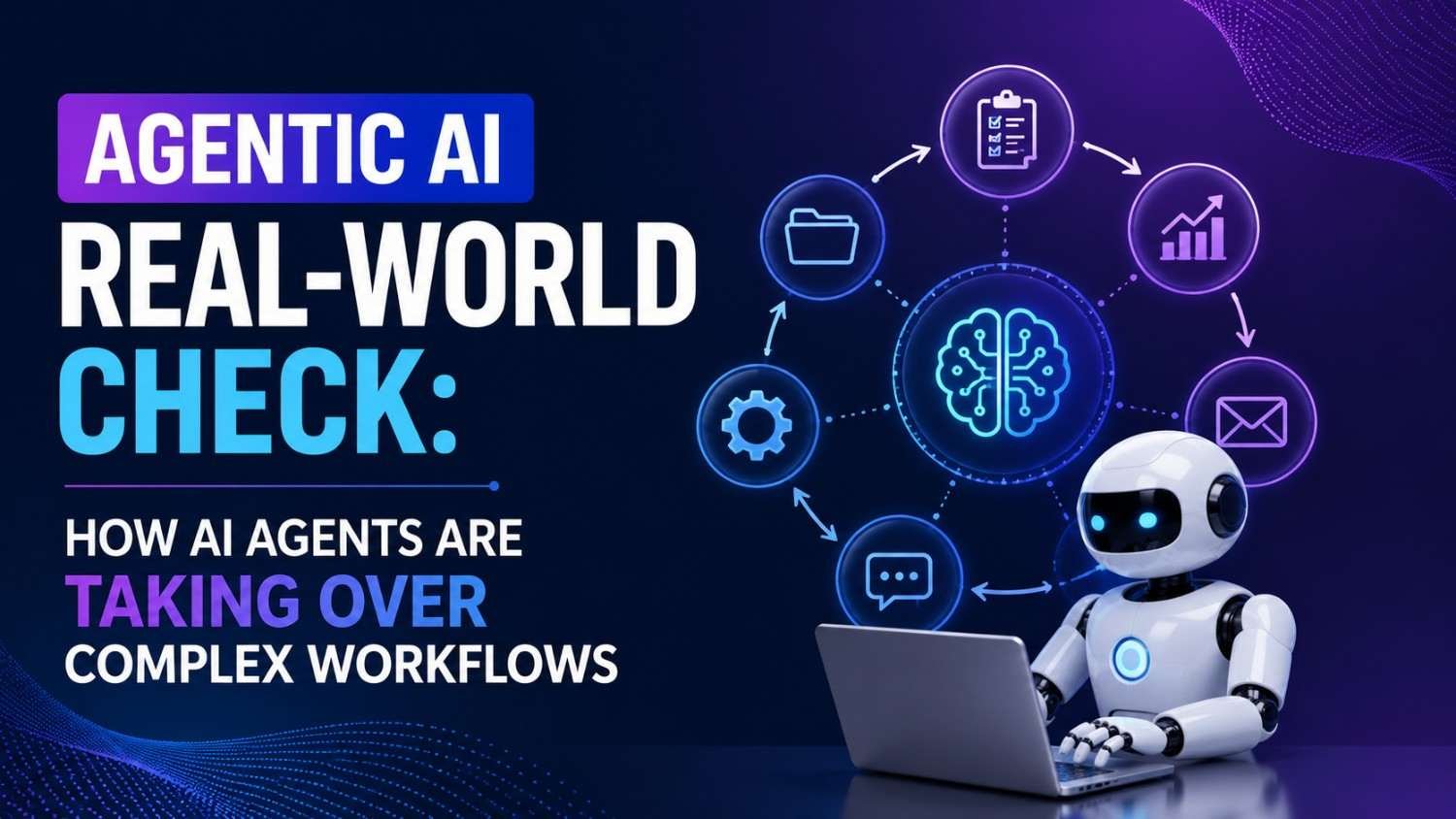
Businesses have been using artificial intelligence for years, to automate those same repetitive chores, like handling customer questions, producing reports, and sifting through data. Sure, these AI tools have boosted efficiency a lot, but they still need plenty of human guidance, especially when a task becomes a longer multi step project. Now, a fresh wave of artificial intelligence is kinda flipping that script. Agentic AI brings in autonomous AI agents that can plan, reason through problems, make decisions, and use multiple software tools, then finish complicated workflows with very little human involvement. They do not just sit there and answer a prompt, they can actively chase objectives, adjust when circumstances shift, and coordinate across different systems to solve business issues. So basically, AI is moving from being a helpful assistant into something closer to an intelligent digital teammate
And this adoption is happening fast, it’s already shifting industries like software development, healthcare, finance, customer service, marketing, manufacturing, and research. Many organizations are finding that these autonomous agents can knock out hours of manual work in minutes, sometimes with better accuracy and less money spent on operations. Still, going in blindly is a risk, because a company really has to understand the upside as well as the constraints of this new technology. You need to find a sensible balance between automation and human oversight, plus security concerns and ethical decision making. In this article we’ll do a real world walkthrough of how Agentic AI works, where AI agents are delivering measurable results right now, what kinds of obstacles organizations should expect and get ready for, and why this could turn into one of the biggest workplace changes of the decade.
What Is Agentic AI?
Unlike the usual AI chatbots that mostly respond to whatever you type, agentic AI is about intelligent systems that can kinda plan on their own, and then carry out complicated tasks, to reach certain goals. These AI agents do not only answer questions, they can also examine information, split up a larger project into smaller steps, make choices, tap into software tools, keep an eye on progress, and even revise their approach when new information comes in.
Key Characteristics of Agentic AI
- Sets and follows long-term objectives.
- Breaks large projects into smaller actions.
- Uses multiple software tools.
- Learns from previous outcomes.
- Requests human input only when necessary.
This makes AI agents significantly more capable than conventional automation systems.
How AI Agents Differ from Traditional Chatbots
A lot of people think AI agents are just more advanced chatbots, kinda the same thing, but there are real differences. Usual chatbots mostly live inside one ongoing conversation . They reply with answers, create text, or summarize stuff based on what you ask. AI agents, though, can keep going after they receive a target or goal. They do digging, interact with actual apps, plan meetings or schedule things, watch outcomes, and bring back the finished deliverable, all of that, without needing you to constantly babysit. Instead of responding to one question they work through full workflows, like step by step.
Why Businesses Are Starting to Use AI Agents
Organizations are getting pressured to boost efficiency while still keeping expenses under control. AI agents help with both, by automating repetitive knowledge work that used to eat a lot of employee hours. Most of the time, they don’t aim to replace employees completely. Instead, they remove boring routine admin chores so professionals can lean into higher-value duties, the stuff with imagination, planning, and decision making.
Business Benefits
- Faster project completion.
- Reduced operational costs.
- Improved productivity.
- Better resource allocation.
- Scalable business operations.
These advantages explain why investment in Business Automation continues to accelerate.
Software Development Is Changing Rapidly
Software engineering is one of the fastest-growing uses of AI Agents, at least in practice. These newer AI coding agents help developers by producing code, spotting bugs in a quick, almost suspicious way, writing documentation, doing pull request reviews, running automated tests and even suggesting optimizations during the whole development project. They don’t really replace people, instead they remove the repetitive “typing stuff again” work, so engineering teams get to spend more time on complex technical puzzles. Development cycles move quicker while still keeping software quality in a good state.
Customer Support Is Getting More Intelligent
Customer service has moved well past those automated FAQ chatbots. Nowadays AI agents can reach customer records, dig through purchase history, confirm account details, handle refunds, adjust subscriptions, escalate the tricky situations, and communicate across multiple channels, all at once sometimes.
Common Customer Service Tasks
- Answer inquiries.
- Process returns.
- Update customer accounts.
- Schedule appointments.
- Generate support summaries.
Human agents remain available for sensitive situations requiring empathy and judgment.
Marketing Teams Are Using AI Agents Daily
Marketing includes a bunch of connected efforts like research, planning a campaign, content creation, SEO optimization, social media timing , email promotion, plus performance reporting. Lately AI agents help marketing teams a lot, kind of coordinating these things on their own while they keep checking how the campaigns perform. Like, an AI agent can look into what’s trending, sketch article plans, adjust keyword targeting, line up the publishing schedule, and then put together weekly results briefs—all inside one single workflow. In practice, this automation really boosts marketing efficiency, by quite a margin.
AI agents also are improving how healthcare operations run
Healthcare orgs are starting to experiment with AI agents for admin help, clinical documentation, appointment coordination, patient messages, and even support for medical research. It’s not really about replacing doctors, or nurses, instead AI systems cut down on paperwork, sort clinical details, summarize patient histories and support scheduling. That means clinicians can stay focused on patient care, without getting swallowed by administrative tasks. Healthcare still looks like one of the best places for responsible AI adoption.
Financial services are automating a lot of complicated work
Banks, insurance companies, and investment firms deal with huge volumes of structured data every day. AI agents can take on automation for compliance monitoring, fraud detection, financial status updates, document checking, customer onboarding, and transaction review. As these systems run, they improve speed, and they also reduce human mistakes on repetitive financial routines. Still, human oversight remains important, especially in higher risk financial decisions.
Manufacturing Is Becoming More Autonomous
Factories are starting to mix up robotics with AI agents, to help with production planning, quality checking, preventive maintenance ,and overall supply chain coordination. In practice the AI folks watch how the equipment is running, spot likely failures before anything actually goes wrong, suggest updated maintenance timings ,and tune the production flow. Some teams also use intelligent agents for workflow optimization, kind of a real time orchestration thing, so it feels more adaptive than the older systems.
Manufacturing Applications
- Equipment monitoring.
- Inventory optimization.
- Predictive maintenance.
- Quality inspections.
- Supply chain coordination.
Smart manufacturing continues to evolve through intelligent automation.
Multi-Agent Systems Multiply Productivity
One of the more exciting developments in Artificial Intelligence is the rise of multi agent systems, and honestly it feels kinda inevitable. Rather than trusting a single AI assistant, organizations tend to put several specialized agents in play, each one doing a slightly different job. They collaborate in practice , not just on paper, and that teamwork can be way more effective than trying to push everything through one mind.
For example:
- One agent researches.
- Another writes content.
- A third reviews quality.
- A fourth analyzes data.
- A fifth prepares final reports.
This collaborative approach closely resembles how human teams operate.
Human Oversight Remains Essential
Even with impressive capabilities, AI agents shouldn’t really work entirely by themselves without supervision. Autonomous systems sometimes misread what the goal is, they may spit out info that’s inaccurate, skip ethical concerns or just get it wrong when the input data is incomplete. In other words, organizations need to set up clear approval routes, especially for serious financial , legal , healthcare , or customer-facing decisions, because that kind of matter can go sideways fast. A responsible rollout mixes automation with actual human expertise, not just passive monitoring, and it usually has to include someone checking what the system thinks.
Challenges Businesses Must Prepare For
While AI agents offer significant opportunities, successful implementation requires thoughtful planning.
Common Challenges
- Data privacy concerns.
- Integration with existing software.
- AI accuracy limitations.
- Employee training.
- Governance and compliance.
Organizations that address these challenges proactively are more likely to achieve successful long-term adoption.
Security and Trust Matter More Than Ever
AI agents often end up touching sensitive business information, like customer records, financial data, internal documents, and operational systems, and well, sometimes more. Because of that businesses have to put in place strong cybersecurity measures such as access controls, encryption authentication, activity monitoring, and regular security reviews . After all, “ trustworthy AI ” is not only about intelligence , it also depends on responsible governance and how people steer it.
The Future of Agentic AI
Industry experts broadly think AI agents will get more capable over the next few years. In time, future systems may coordinate across departments, bargain with other AI agents, handle complicated business projects, do scientific research , tune logistics, and help with executive decision-making with little or no daily supervision. Instead of fully replacing human professionals, AI agents will likely work as collaborative digital coworkers that boost productivity across almost every industry. So the future workplace becomes a mix of human creativity and smart automation , kind of like both sides pulling in the same direction .
Best Practices for Businesses Adopting Agentic AI
Organizations that plan to roll out AI agents should start by picking well defined business problems first , not just adopting AI because it’s popular.
Recommended Implementation Steps
- Start with repetitive workflows.
- Maintain human approval for critical decisions.
- Train employees alongside AI deployment.
- Measure productivity improvements.
- Continuously monitor AI performance.
Gradual implementation reduces risk while maximizing long-term value.
Key Takeaways
- Agentic AI goes beyond traditional chatbots.
- AI agents independently complete complex workflows.
- Businesses use AI agents across software development, healthcare, finance, manufacturing, and marketing.
- Human oversight remains essential.
- Multi-agent systems increase productivity.
- Security and governance should be priorities.
- AI agents automate repetitive knowledge work.
- Organizations should implement AI gradually.
- Responsible adoption improves long-term success.
- Workflow Automation is becoming a competitive advantage.
Conclusion
Agentic AI is one of those biggest leap in Artificial Intelligence since generative AI started becoming a thing. Instead of only reacting to prompts , these autonomous AI Agents sort of plan, think through, coordinate various software instruments, and then finish tangled business workflows with real efficiency. The tech is still moving forward, but you can already see its effects in the real world, across software building, healthcare, finance, manufacturing, and customer support. Companies that bring this in carefully, mixing automation with solid governance , good cybersecurity, and active human oversight, will likely be in a stronger spot to lift productivity, cut down operational expenses, and stay competitive in an economy that’s increasingly powered by AI. And as more organizations adopt intelligent automation, these AI agents seem ready to turn into useful digital teammates, not just plain software tools.
Frequently Asked Questions
1. What is Agentic AI?
Agentic AI refers to autonomous AI systems that can plan, make decisions, use multiple software tools, and complete complex workflows with minimal human intervention.
2. How are AI agents different from chatbots?
Traditional chatbots mainly answer prompts, while AI agents can independently execute multi-step tasks, monitor progress, interact with applications, and achieve broader objectives.
3. Which industries benefit most from AI agents?
Software development, healthcare, finance, manufacturing, customer service, logistics, marketing, and research organizations are among the leading adopters of AI agent technology.
4. Can AI agents replace human workers?
Currently, AI agents are designed to assist professionals by automating repetitive tasks and improving productivity rather than fully replacing human expertise, creativity, and judgment.
5. What should businesses consider before adopting Agentic AI?
Organizations should evaluate workflow suitability, ensure data security, establish governance policies, provide employee training, maintain human oversight, and continuously monitor AI performance for reliable and responsible deployment.