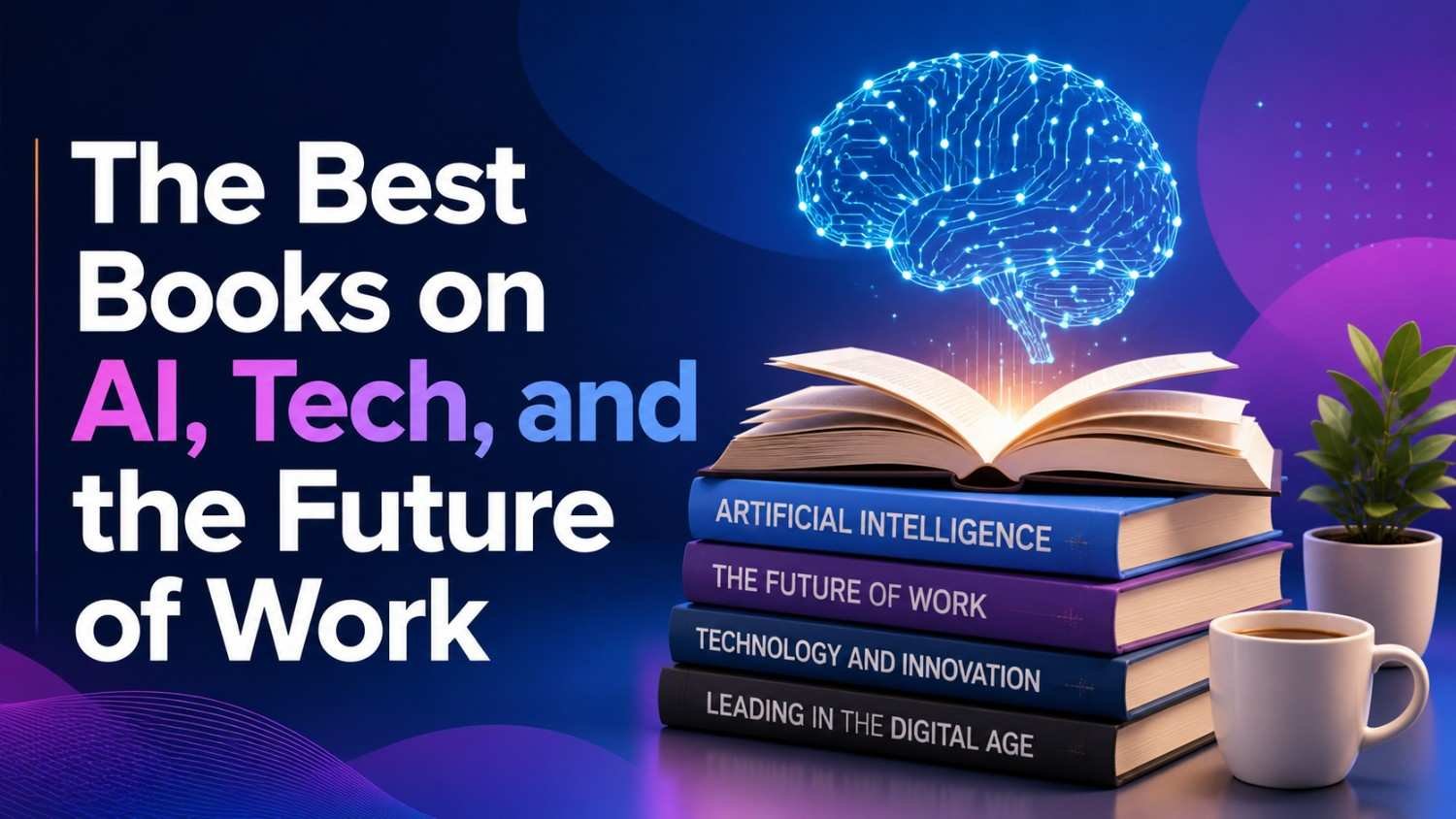
Artificial intelligence and those emerging technologies are changing how people do their work, how they learn, how they communicate , and how they build businesses. New AI tools show up almost every week , while automation, robotics, remote teamwork, and data based decisions are slowly reshaping older careers. For professionals, and also for curious readers, trying to keep up can feel kind of overwhelming because the tech itself often advances faster than most people can process the wider impact.
Honestly, books can be a solid way to step back from the everyday flood of tech news, and see the bigger picture. The best books on Artificial Intelligence and technology don’t just describe what a given tool can do, they go further, they dig into how innovation rubs off on people, on organizations, on jobs, leadership, creativity , and society in general. Whether you are running a business, studying something , working in technology, or you just want a clearer view of what comes next, the right books can help you form a more informed take on where work and technology might be going next.
Why Read Books About AI and Technology?
Technology news might tell you what happened today but books tend to help explain why it matters. A well researched book gives context that is usually missing from quick pieces and social media posts, and somehow that makes a difference. It can link new technological developments with economics, psychology, business strategy, ethics and overall human behavior, even when the headline is pretty narrow. That wider lens feels especially useful when you think about the Future of Work. Instead of only asking which jobs AI could replace , readers can dig into how technology might reshape job design and productivity, education and leadership too. Then you also start seeing how the relationship between humans and machines could evolve over time, not just right now.
1. Life 3.0 by Max Tegmark
Max Tegmark’s Life 3.0 kind of circles around one of the biggest question areas in advanced AI, namely what happens if artificial intelligence gets much more capable than what we’re used to. In the book, he looks at possible futures that mix AI , intelligence, employment, society, and human values , and it doesn’t really treat technology like it’s automatically a villain or a savior. Instead it sort of pushes the reader to ask how people can, you know, steer the development and also the use of increasingly powerful systems. If you’re the kind of reader who’s into AI and society, this is a solid starting point, a kind of doorway into the broader concerns around advanced artificial intelligence.
2. Co-Intelligence by Ethan Mollick
Ethan Mollick’s Co-Intelligence is more about how humans can work with AI, not just see it as a simple replacement for human labor. The book explores practical method(s) for turning AI into a collaborator, a kind of tutor, a creative partner, and even a productivity assistant. What makes it especially helpful is how it talks about everyday work, so professionals can see the path from idea to actual workflow. It’s also one of the more approachable AI books for people in business, because it keeps technical concepts connected to real workplace situations, instead of floating off into abstraction.
3. The Second Machine Age by Erik Brynjolfsson and Andrew McAfee
The Second Machine Age looks closely at how digital tools affect productivity, economic growth, jobs, and business decisions. The authors dig into how human capabilities interact with machines that keep getting more and more powerful. This book is particularly good for understanding why technological progress can open up new opportunities, while at the same time unsettling established industries and roles. If someone is researching the Future of Work, it gives helpful economic and technological context, sorta like a map you can use while walking through the changes.
4. The Coming Wave by Mustafa Suleyman and Michael Bhaskar
The Coming Wave basically looks at a wide mix of new technologies, things like AI, and biotechnology, and it tries to see how fast advancing tech might shake up society. There are a bunch of hard questions it keeps circling around: control , governance, security, and the whole idea of technological power. It kind of pushes you to not just think about any single AI tool, but more like, what occurs when powerful technologies get broadly available. It feels especially connected for people who care about the overlap between Artificial Intelligence, business, policy, and day to day society, even if that sounds a bit broad.
5. AI Superpowers by Kai-Fu Lee
Kai-Fu Lee’s AI Superpowers goes through the growth of AI using, the backstories of the United States and China, in a sort of lived way. The book talks about innovation, business rivalry, jobs, and bigger economic shifts. It also asks how AI may affect workers and entire industries once organizations lean more heavily into automation. Even though parts of the tech landscape have already changed since it was released, the book still works pretty well for getting the geopolitical and economic angles of AI, without pretending everything stays the same.
6. The Age of AI by Henry Kissinger, Eric Schmidt, and Daniel Huttenlocher
The Age of AI looks at artificial intelligence through a wider intellectual and societal lens. Instead of zeroing in only on what the tech can technically do, it explores how AI could shape knowledge, decision-making, security, and even the way humans understand the world. That makes it a solid option if you want to think past software features and productivity gadgets, and more toward the deeper effects.
8. The Industries of the Future by Alec J. Ross
Alec Ross sort of looks at industries and technologies that might steer the global economy, you know, in the long run. In the book he talks about robotics, cybersecurity, artificial intelligence, digital technologies, and healthcare innovation, all kind of woven together in a way that feels practical but still broad. It’s not really just theory either, it gives a framework for thinking about where economic opportunities may show up as tech keeps advancing, especially for readers who are also thinking about careers, technology and what might happen next in the job market.
9. The Technology Trap by Carl Benedikt Frey
The Technology Trap is a book that goes back through history, it reviews technological change and employment in earlier eras. Instead of pretending automation is some totally brand-new thing, Frey basically treats it like a repeat episode, you can compare older moments of disruption with what we’re seeing now. That’s why it feels useful, because it shows technology doesn’t only “do one thing”. It can make winners and losers, and the outcome depends on things like education, economic structures, institutions, and also how organizations roll out new technologies, sometimes carefully, sometimes not.
10. The Age of Surveillance Capitalism by Shoshana Zuboff
Not every tech book has to center on AI, and this one kind of proves that point. Shoshana Zuboff’s The Age of Surveillance Capitalism digs into how companies gather personal data, then use it to nudge products, advertising, and digital experiences. The book makes it easier to understand the economic engine behind many digital platforms, and it also raises questions about privacy, power, and how human behavior gets shaped when the system is constantly watching. If someone is into digital transformation, this is a reminder that understanding data matters almost as much as understanding artificial intelligence.
What These Books Teach About the Future of Work
Even though these books come at technology from different angles, a few themes sort of show up again and again. Like, first there’s this idea that technological change doesn’t just erase work. It kind of redirects it. Sure some tasks get automated, but then other tasks become more valuable, or at least more attention-worthy. The second theme is that human skills still matter, actually, a lot. Communication, creativity, critical thinking, leadership, judgment, relationship building, and adaptability can end up being even more valuable when machines handle the repetitive stuff. Third, continuous learning is starting to feel non optional. People can’t always rely on the same stable set of technical skills for an entire career.
How AI Could Change Everyday Jobs
AI is already able to help with writing, research, coding, data analysis, customer service, marketing, design, and different administrative tasks. Still, the biggest shift might not be full job replacement, not yet. It might be more like rebuilding jobs around human-AI cooperation. A marketing professional could use AI to interpret campaign data. A software developer might use AI to draft and then check code. A researcher may rely on AI to sort and organize information, before using human judgment. That’s why grasping AI and Automation is becoming useful across many industries, not just inside technology companies.
The Human Skills That Matter Most
As AI handles more routine tasks, certain human capabilities can become more important.
Critical Thinking
Professionals need to evaluate whether AI-generated information is accurate, relevant, and appropriate.
Communication
Technology cannot eliminate the need to explain ideas clearly to customers, colleagues, and stakeholders.
Creativity
AI can generate possibilities, but people still need to decide which ideas are meaningful and useful.
Adaptability
The ability to learn new tools and adjust to changing workflows may become one of the most valuable career skills.
Judgment
Important decisions often require context, ethics, experience, and responsibility that cannot be reduced to a simple automated output.
How to Choose the Right Technology Book
You don’t really need to plow through every technology book that’s out there. Start with what you actually want, like what’s the objective, in the first place. If you’re aiming for practical, jobsite advice, pick books that are really about AI collaboration and productivity. If your interest is economic disruption, go for titles about automation and employment. And if you’re trying to understand the bigger social ripples of AI, then look for ethics, governance and society type books. You can even mix and match these angles. For example, reading one more optimistic tech book next to a sharper critique can help you get a more balanced view instead of just swallowing one storyline, no questions asked.
A kinda simple reading path for beginners
If you’re new, don’t start with the most technical book you can locate. Begin with an approachable intro to AI and workplace change. After that, move into books covering automation, economics, and society. Once you have that basics layer, you can branch into more specialized areas such as AI governance, data privacy, robotics, cybersecurity and technological leadership. This sequence tends to make technology books easier to digest early on, then it widens your knowledge step by step.
What professionals can take away
The main takeaway from these books is that technology shouldn’t be treated only like a box of tools. AI and other digital technologies can nudge how companies arrange work, how employees build skills, how leaders decide things, and even how customers interact with businesses. People who understand that broader context can make better judgement calls about when to adopt tech, versus when human expertise should stay in the driver seat.
Key Takeaways
- AI is changing tasks as well as entire industries.
- Technology can complement human abilities instead of simply replacing workers.
- Critical thinking and adaptability are increasingly valuable.
- AI literacy is becoming useful across many professions.
- Data, privacy, and governance are important parts of technological change.
- Reading different perspectives helps create a more balanced understanding.
- The best technology books explain not only what technology does but why it matters.
Conclusion
The best books on AI, tech, and the future of work seem to give you something that daily technology news kind of can’t, not really context, I mean. They help people wrap their heads around how artificial intelligence, automation, data, robotics, and digital transformation might nudge careers, companies, markets, and even society. Something like Life 3.0, Co-Intelligence, The Second Machine Age, The Coming Wave, and Human + Machine each comes with a slightly different lens, so readers can think more critically about what technological change is actually doing. And you do not have to become a full-on technology specialist just to get value from the ideas. Even a basic understanding of where things are heading can help professionals make steadier career choices, adjust to shifting workplaces and use new tools more carefully, or let’s say, with better intention.
Frequently Asked Questions
1. What are the best books about AI for beginners?
Co-Intelligence is a practical starting point for understanding how people can work with AI. Life 3.0 is useful for readers who want to explore the broader implications of advanced AI.
2. Which books explain the future of work?
The Second Machine Age, Human + Machine, and The Technology Trap are strong choices for understanding automation, employment, productivity, and human-machine collaboration.
3. Are technology books useful for non-technical professionals?
Yes. Many modern technology books focus on business, society, leadership, careers, and workplace change rather than technical programming concepts.
4. What should I read to understand AI’s impact on jobs?
Start with books such as The Technology Trap and Human + Machine. They provide useful perspectives on automation, employment, and how humans can work alongside intelligent technologies.
5. How can reading about AI help my career?
Understanding technological trends can help you identify changing workplace expectations, develop relevant skills, evaluate new tools, and adapt your career strategy as technology evolves.