Science fiction is really interesting because it thinks about things that’re not possible in our world today. It talks about traveling to stars, robots that can think and moving through time. It also talks about people living in the future and what kind of technology they might have. Science fiction makes us think about what the future could be like and it also makes us think about things like people, society and how science is changing. A lot of the things we use today like our phones going to space robots that can think and virtual reality were first thought about in science fiction books a time ago. Even though science fiction is about the future it is not about technology. It is about people being curious coming up with new ideas thinking about what is right and wrong and what happens when we make choices.
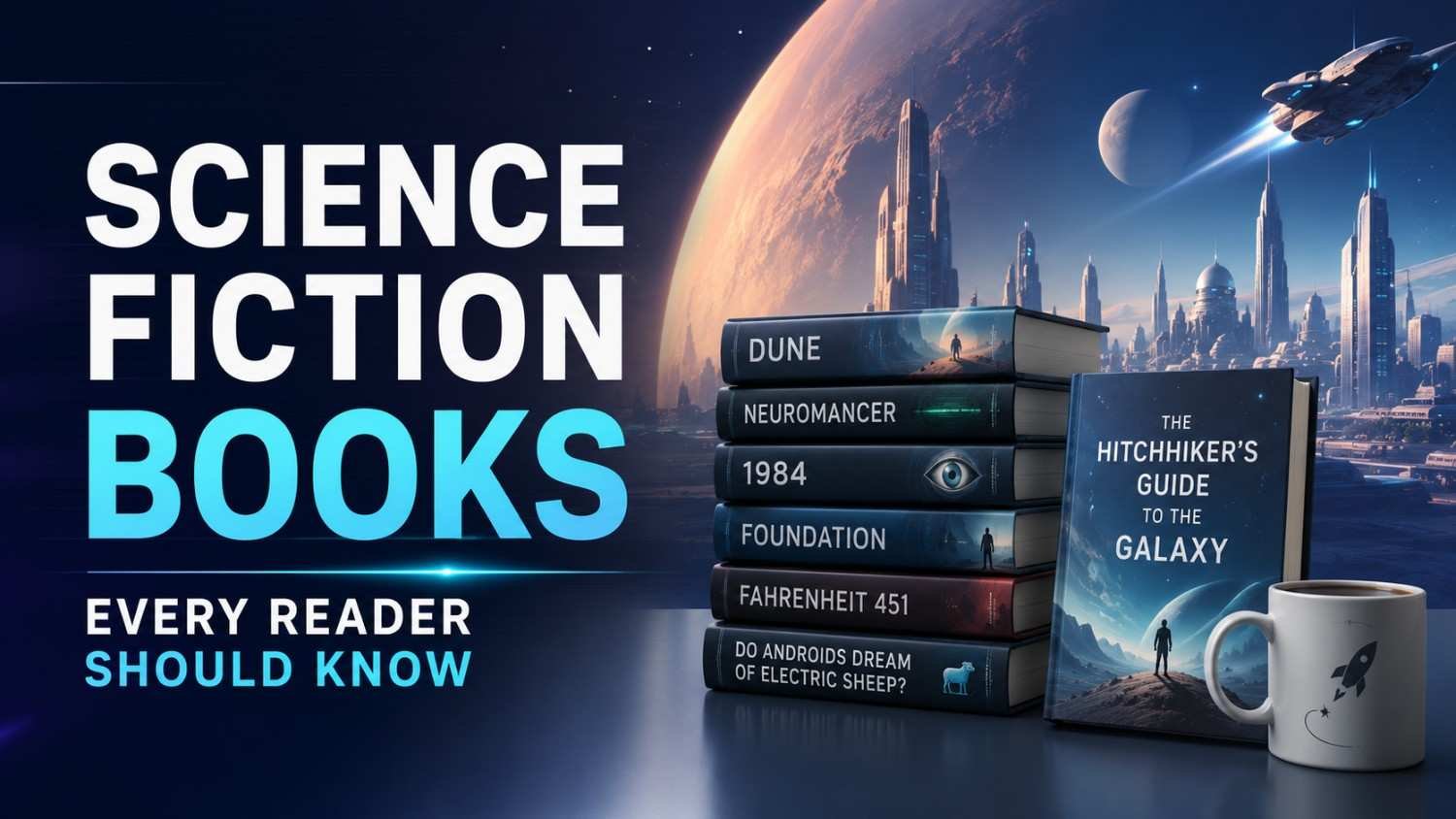
For people who’re new to science fiction it can be hard to choose a book because there are so many different kinds of stories. Some books are adventures and some books make you think deeply about things. Some stories are about people trying to survive on planets and some are, about robots that can think, governments taking care of the earth or meeting people from other planets. The best science fiction books are fun to read. They help you imagine things and think critically. In this guide we will talk about the Science Fiction Books Every Reader Should Know. We will look at old books that are still good today and new books that are important and that lots of people like to read.
Why Science Fiction Continues to Inspire Readers
Science fiction combines imagination with scientific possibilities, allowing readers to explore worlds that challenge conventional thinking. Many of the genre’s greatest authors use fictional settings to discuss real-world issues such as technology, ethics, politics, environmental change, and human nature.
Reading science fiction also encourages creativity by introducing ideas that stretch the imagination while remaining grounded in logical possibilities.
Why Readers Love Science Fiction
- Explores futuristic ideas.
- Encourages creative thinking.
- Introduces advanced technology.
- Raises philosophical questions.
- Combines adventure with science.
- Expands imagination.
Science fiction remains one of literature’s most innovative genres.
1. Dune by Frank Herbert
Widely considered one of the greatest Science Fiction Books ever written, Dune follows Paul Atreides as he navigates political conflict, survival, and destiny on the desert planet Arrakis. The novel explores themes of leadership, ecology, religion, power, and human evolution while creating one of the richest fictional worlds in literature.
Why You Should Read It
- Incredible world-building.
- Complex political storytelling.
- Memorable characters.
- Timeless philosophical themes.
2. Foundation by Isaac Asimov
Isaac Asimov’s Foundation series remains one of the most influential works in science fiction history. The story follows mathematician Hari Seldon as he develops a scientific method capable of predicting the future of civilization, leading to an ambitious plan to preserve knowledge during the collapse of a galactic empire.
Highlights
- Brilliant scientific concepts.
- Large-scale storytelling.
- Fascinating political strategy.
- Rich historical inspiration.
3. The Martian by Andy Weir
This modern classic follows astronaut Mark Watney after he becomes stranded on Mars following a failed mission. Using science, engineering, creativity, and determination, he fights to survive while waiting for a possible rescue.
Why Readers Love It
- Realistic science.
- Inspiring problem-solving.
- Engaging humor.
- Fast-paced storytelling.
4. Ender’s Game by Orson Scott Card
In a future where humanity faces an alien threat, gifted children receive military training to prepare for an interstellar conflict. The novel explores leadership, morality, strategy, and the psychological cost of war.
Best Features
- Intelligent storytelling.
- Emotional depth.
- Strong character development.
- Ethical dilemmas.
5. Neuromancer by William Gibson
Often credited with shaping the cyberpunk genre, Neuromancer introduced readers to cyberspace, hacking, artificial intelligence, and corporate power long before these topics became mainstream. Many modern technology stories draw inspiration from this groundbreaking novel.
Why It’s Important
- Visionary concepts.
- Cyberpunk atmosphere.
- AI exploration.
- Technological innovation.
6. Hyperion by Dan Simmons
Hyperion combines science fiction, mystery, philosophy, and adventure into a deeply layered narrative. Multiple characters tell interconnected stories while traveling toward the mysterious Time Tombs.
Highlights
- Exceptional storytelling.
- Rich world-building.
- Unique narrative style.
- Thought-provoking ideas.
7. The Left Hand of Darkness by Ursula K. Le Guin
This award-winning novel examines gender, politics, culture, and communication through the story of an envoy visiting a distant planet. Its exploration of identity and society continues to influence writers today.
Why Read It
- Powerful social themes.
- Outstanding writing.
- Memorable characters.
- Deep philosophical questions.
8. Snow Crash by Neal Stephenson
Blending virtual reality, artificial intelligence, and internet culture, Snow Crash predicted many aspects of today’s digital world. Its fast-paced narrative combines action, satire, and futuristic technology.
Key Strengths
- Creative concepts.
- Fast action.
- Memorable world-building.
- Visionary technology.
9. Project Hail Mary by Andy Weir
This bestselling novel follows a lone scientist who awakens aboard a spacecraft with no memory of his mission. As the story unfolds, readers experience suspense, humor, scientific discovery, and one of the most memorable friendships in modern science fiction.
Why It’s Worth Reading
- Excellent pacing.
- Realistic science.
- Emotional storytelling.
- Inspiring optimism.
10. Brave New World by Aldous Huxley
This classic dystopian novel explores a future society controlled through technology, genetic engineering, and psychological conditioning. Its themes remain highly relevant in discussions about technology and society.
Why It Endures
- Timeless social commentary.
- Powerful themes.
- Thought-provoking questions.
- Influential storytelling.
11. Childhood’s End by Arthur C. Clarke
Arthur C. Clarke explores humanity’s evolution after peaceful alien visitors transform civilization. Rather than focusing on conflict, the novel examines progress, knowledge, and humanity’s ultimate destiny.
Highlights
- Big philosophical ideas.
- Excellent pacing.
- Memorable ending.
- Visionary storytelling.
12. The Three-Body Problem by Liu Cixin
This internationally acclaimed novel combines physics, first contact with extraterrestrial civilizations, and political history into an ambitious science fiction epic. Its scientific concepts and global perspective have introduced many new readers to modern Chinese science fiction.
Why Readers Recommend It
- Original scientific ideas.
- Large-scale storytelling.
- Intelligent mystery.
- International perspective.
How to Choose the Right Science Fiction Book
Every reader enjoys different aspects of science fiction.
If You Like Space Exploration
- The Martian
- Project Hail Mary
- Dune
If You Enjoy Artificial Intelligence
- Neuromancer
- Foundation
- Snow Crash
If You Prefer Deep Philosophy
- The Left Hand of Darkness
- Childhood’s End
- Brave New World
If You Want Fast-Paced Adventure
- Ender’s Game
- Project Hail Mary
- The Martian
Choosing books based on your interests makes the reading experience even more enjoyable.
Benefits of Reading Science Fiction
Science fiction offers much more than entertainment. It expands imagination while encouraging readers to think critically about technology and society.
Benefits
- Encourages creativity.
- Improves critical thinking.
- Expands scientific curiosity.
- Develops imagination.
- Explores ethical questions.
- Inspires innovation.
Many scientists, engineers, and entrepreneurs credit science fiction for inspiring their careers.
Common Mistakes New Sci-Fi Readers Should Avoid
Beginners sometimes avoid science fiction because they assume every book is highly technical.
Mistakes to Avoid
- Starting with overly complex novels.
- Expecting constant action.
- Ignoring classic authors.
- Reading without understanding the setting.
- Judging the entire genre from one book.
Beginning with accessible novels creates a better introduction to science fiction.
Conclusion
The Science Fiction Books Every Reader Should Know keep inspiring generations, because they mix imaginative storytelling with pointed questions around technology, humanity, and what might come next. Depending on what you’re in the mood for , you might pick the huge political atmospheres of Dune, the more grounded science realism of The Martian, the far-reaching visions inside Foundation, the sharp cyberpunk experiments of Neuromancer, or the heartfelt problem solving adventure in Project Hail Mary. Each novel kinda points at the future from a different angle and it makes you wonder things you didn’t expect. They’re not just fun to read either, they push readers to think carefully about science, ethics, social structure,and human potential. If you dive into these durable favorites, you get a really strong feel for the best that Science Fiction Books can offer.
Frequently Asked Questions
1. Which science fiction book is best for beginners?
The Martian by Andy Weir and Project Hail Mary are excellent starting points because they combine engaging storytelling, realistic science, humor, and accessible writing.
2. Why are science fiction books so popular?
Science Fiction Books explore futuristic technology, space exploration, artificial intelligence, and human possibilities while encouraging readers to imagine different futures and think critically about real-world issues.
3. Are science fiction books based on real science?
Many science fiction novels are inspired by genuine scientific theories and technological possibilities, although authors often expand these ideas creatively to build fictional worlds and stories.
4. Which science fiction novel has had the biggest influence?
Many experts consider Dune, Foundation, and Neuromancer among the most influential because they shaped modern science fiction, inspired countless authors, and influenced films, television, and technology.
5. What makes a great science fiction novel?
The best science fiction combines imaginative ideas, compelling characters, believable world-building, meaningful themes, and thought-provoking questions that remain relevant long after the story ends.