Artificial intelligence has already shifted many industries, kinda quietly, by letting companies automate repetitive chores, sharpen decision making, and analyse huge sets of data. But healthcare robotics is a lot tougher. Unlike chatbots or image generation models, which basically learn from digital stuff, medical robots have to deal with the real world, safely. So they must interpret motion, understand objects, read human behaviour, and cope with environments that keep changing, minute by minute. The problem is that getting enough real medical data to train them is expensive and also takes a long time, and in many places it is restricted because of privacy , plus safety rules. Because of that gap in high quality training material, progress on intelligent healthcare robots has been slower than you might expect, even with fast AI progress.
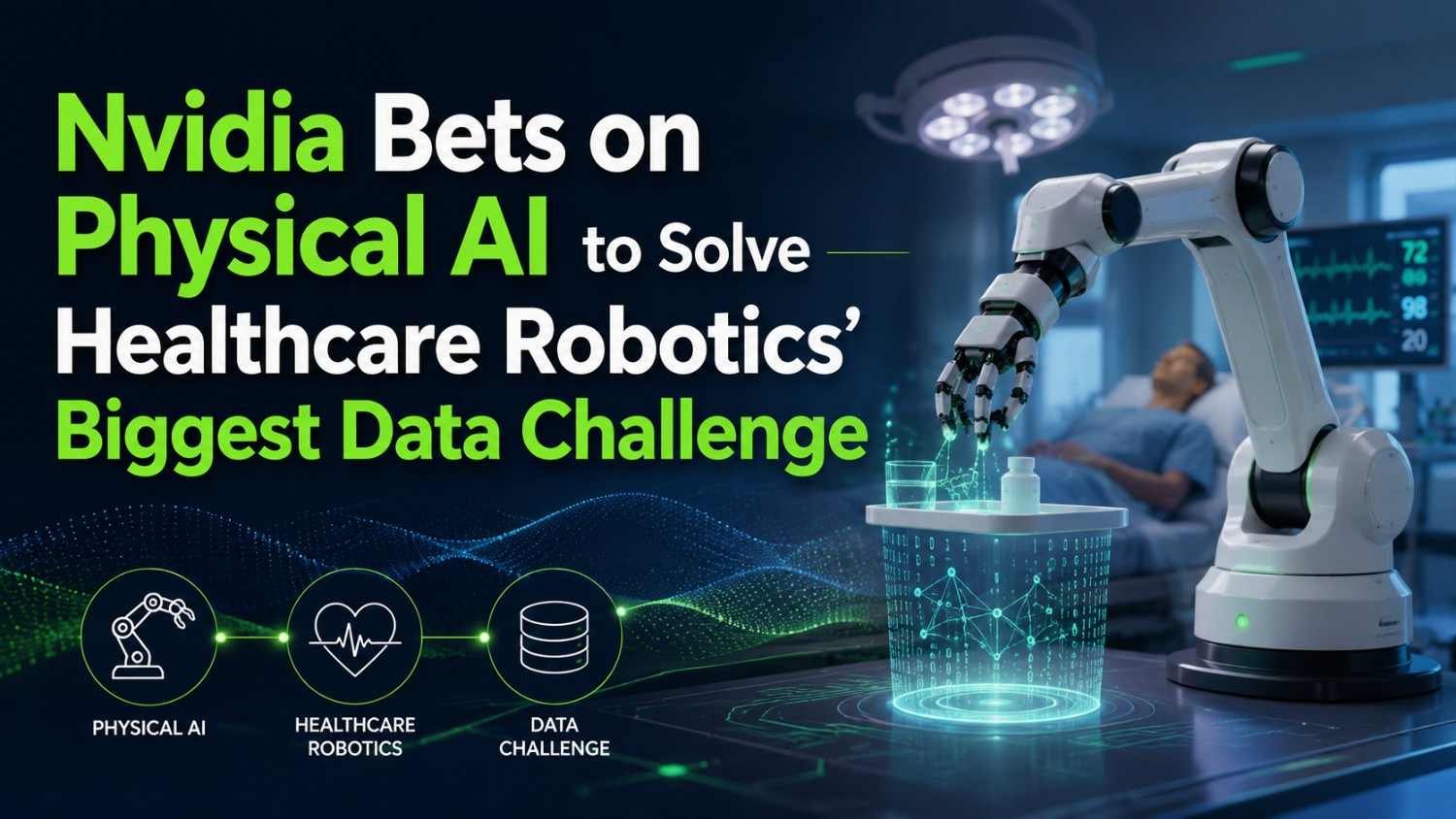
NVIDIA thinks the solution is Physical AI, a fresh path that blends robotics, simulation, synthetic data, and newer AI models so robots can learn to do real world healthcare work before they ever step into hospitals. Rather than counting only on physical demonstrations, NVIDIA’s Medical Physics Simulation framework lets robots practise inside realistic virtual worlds. In turn this cuts down the heavy need for massive amounts of actual patient data. If this works the way NVIDIA imagines, it could speed up safer medical robots, boost healthcare automation, and help hospitals handle workforce shortages without dropping their standards for patient care. Here , we’ll look at NVIDIA’s bigger plan, why physical AI really matters, and how it might change the next era of healthcare robotics.
What Is Physical AI?
Physical AI is basically artificial intelligence made to grok and deal with the physical world. Instead of the usual AI that just handles text, pictures, or code, physical AI shows up inside robots and autonomous machines. They sense what’s around them, decide on actions, and carry out tasks safely in real life, not in a clean lab box. In healthcare, it could mean robots that can move through hospital hallways, help with patient care, shuttle medical supplies, or even assist surgical teams while things keep shifting during the day. NVIDIA is putting a lot of money into this topic, because physical AI needs more than just software. It asks for true, realistic learning via simulation, through sensors, and on robotics platforms, so it can actually behave.
Key Features
- Real-world interaction.
- Intelligent decision-making.
- Environmental awareness.
- Safe robotic movement.
- Continuous learning.
Why Healthcare Robotics Faces a Data Problem
Training a chatbot is kinda straight, mostly because billions of text documents are out there online. But training a healthcare robot is far more complex because every little movement has to be safe, accurate , and reliable , no exceptions really. Hospitals can’t just record thousands of patient interactions for AI training. Not with privacy regulations, ethical concerns and clinical risks stacked up. And even when they try, collecting enough high-quality robotic training data takes a lot of time as well as serious money. That lack of real-world data has turned into one of the biggest hurdles, for building truly intelligent medical robots.
Major Challenges
- Limited real-world medical data.
- Patient privacy regulations.
- Expensive data collection.
- Safety requirements.
- Complex hospital environments.
How NVIDIA Plans to Solve the Problem
Instead of leaning fully on actual hospital records , NVIDIA is turning to simulation tech that feels real enough to train in, you know. Their Medical Physics Simulation framework basically sets up virtual hospitals, where robots can practise moving around, handling things, spotting objects, and even doing patient interactions again and again , but with zero danger for patients. In the end, those simulated runs make useful synthetic data, which helps the robots be ready for real deployment without relying so much on collecting data from physical places.
Core Technologies
- Digital simulation.
- Synthetic datasets.
- AI foundation models.
- Robotics platforms.
- Physics-based environments.
The Importance of Synthetic Data
Synthetic data is basically fabricated information, that imitates real world settings in a pretty close way. In healthcare robotics , synthetic surroundings let robots try out thousands of situations that would be impossible or not safe to reproduce directly inside hospitals. Through rehearsal in simulation, the robots can figure out how to deal with emergencies, weave through crowded hallways, manage devices, and engage with people in a careful manner before they finally move into clinical environments.
Benefits
- Faster training.
- Lower costs.
- Better scalability.
- Improved safety.
Simulation Creates Better Robots
Simulation lets developers check robotic systems across all sorts of situations, without putting patient safety at risk. In hospitals it gets kind of unpredictable, there are moving staff , room layouts that keep shifting, medical equipment that’s never exactly the same, and the emergency responses can flip fast. Because of this, simulation helps robots practise dealing with those shifting factors again and again, until they start to operate reliably.
Simulation Advantages
- Safe experimentation.
- Unlimited practice.
- Faster improvements.
- Better reliability.
Potential Applications in Healthcare
The future of Healthcare Robotics feels like it goes way past surgical help. Physical AI could kind of support hospitals by handling automated logistics, patient monitoring, rehabilitation aid, pharmacy automation, laboratory workflows, and also elderly care, in practice. As robots become more capable, healthcare professionals might end up spending less time doing repetitive physical work and more time thinking about actual patient treatment.
Possible Uses
- Medicine delivery.
- Patient transport.
- Rehabilitation support.
- Hospital logistics.
- Surgical assistance.
Improving Patient Safety
Healthcare stays among the most safety sensitive industries, in the world. Before robots, interact with patients they kinda need to show predictable behaviour across a bunch of weird scenarios. Physical AI, joined with realistic simulation lets developers spot potential mistakes long before anything ships, which reduces risks and also improves confidence, for healthcare providers. Safety validation still is one of NVIDIA’s main priorities as it keeps expanding its robotics ecosystem.
Safety Benefits
- Better testing.
- Risk reduction.
- Reliable performance.
- Clinical confidence.
Addressing Healthcare Workforce Shortages
Many healthcare systems worldwide are dealing with rising staff shortages, while patient demand keeps going up and up. Physical AI isn’t meant to supplant doctors or nurses . Rather, intelligent robots can take over repetitive operational tasks, move equipment around, orchestrate the flow of supplies, and also support routine activities so that medical professionals can spend more time on direct patient care.
Workforce Support
- Reduce repetitive work.
- Improve efficiency.
- Support healthcare staff.
- Increase productivity.
Why NVIDIA Is Investing in Physical AI
NVIDIA kind of moved past just making graphics processors, and now it’s like a full-stack AI computing company, more or less. Its bets on robotics platforms, simulation software, AI models, accelerated computing, and developer ecosystems show that long game, a long-term strategy aimed at enabling physical AI, across healthcare, manufacturing, logistics, and autonomous systems, too. Healthcare is one of the most valuable use cases, because dependable robotics could improve patient outcomes in a real way while also helping with day-to-day operational headaches.
NVIDIA’s Focus Areas
- Accelerated computing.
- AI infrastructure.
- Robotics software.
- Simulation technology.
- Healthcare innovation.
Challenges That Still Remain
Even though physical AI has enormous promise, there are still pretty big hurdles left before healthcare robots are everywhere. Developers have to keep dialing in robotic perception, reasoning, fast decision making, meeting regulatory rules, tightening cybersecurity, and making everything fit into the hospital’s existing workflows. And, yeah, getting public trust isn’t optional too it’s more like a prerequisite, plus there needs to be clear AI governance so people can see what’s going on, otherwise adoption will stall.
Remaining Challenges
- Regulatory approval.
- Data security.
- Public trust.
- Technical complexity.
- Clinical validation.
What This Means for the Future of AI
NVIDIA’s newest initiative really shows a wider change happening in artificial intelligence , from “systems that grasp digital info” to systems that can, kind of, deal with the physical world in a more responsive way. As Physical AI keeps maturing, lots of industries—like healthcare, manufacturing, logistics, agriculture, and even autonomous transportation—could see real gains from robots that learn quicker via simulation , not only depending on pricey real-world training. If that works as intended, innovation might speed up a lot , and AI rollouts could end up being safer as well as easier to scale.
Best Practices for Organisations Looking Into Healthcare Robotics
Healthcare organisations that are evaluating robotic technologies should first find the operating areas where automation brings measurable returns. Then, it helps to put money into secure AI infrastructure, keep solid data governance in place, team up with trusted technology providers, and make sure staff get continuous training. Before any big rollout, pilot programs should run , simulation-based testing should happen, and safety validation needs to be rigorous. When you combine clinical expertise with AI innovation, you get a more measured strategy that supports both patient outcomes and day to day operational efficiency.
Key Takeaways
- Physical AI helps robots understand the real world.
- Healthcare robotics requires more than traditional AI models.
- Simulation reduces dependence on real patient data.
- Synthetic datasets accelerate robot training.
- Patient safety remains the highest priority.
- Healthcare staff shortages increase demand for automation.
- NVIDIA is investing heavily in robotics infrastructure.
- Hospitals may benefit from smarter operational support.
- Regulatory and ethical challenges still require attention.
- Physical AI represents the next major evolution in artificial intelligence.
Conclusion
NVIDIA’s investment in Physical AI feels like a pretty major move, toward easing one of healthcare robotics biggest hurdles, namely the lack of truly strong training data. The idea is that by stitching together advanced simulation, synthetic datasets, and AI-powered robotics platforms, the company wants medical robots to pick up skills safely and fairly quickly, before they ever show up in real clinical settings. Of course, there are still important technical, ethical, and regulatory issues hanging around , but if they can work through those, this kind of method could speed up innovation across healthcare robotics. It may also help keep patients safer and give healthcare professionals more intelligent automation tools, instead of more manual busy work. And since AI keeps stretching past just digital apps and moving into the physical world, simulation-driven learning might end up being the basic layer for the next wave of medical robotics and overall healthcare innovation.
Frequently Asked Questions
1. What is Physical AI?
Physical AI refers to artificial intelligence designed to power robots and autonomous machines that interact safely with the real world using perception, reasoning, and physical movement.
2. Why is healthcare robotics difficult to train?
Healthcare robots require large amounts of real-world training data, but patient privacy, safety regulations, and the complexity of hospital environments make data collection challenging.
3. How does NVIDIA’s simulation approach help?
NVIDIA uses realistic virtual environments to generate synthetic data, allowing robots to practise healthcare tasks repeatedly before operating in real hospitals.
4. Will healthcare robots replace doctors and nurses?
No. Current physical AI systems are designed to support healthcare professionals by automating repetitive tasks and improving operational efficiency, not replacing clinical expertise.
5. What industries could benefit from Physical AI besides healthcare?
Manufacturing, logistics, agriculture, autonomous transportation, warehousing, and industrial automation are among the sectors expected to benefit significantly from advances in physical AI.