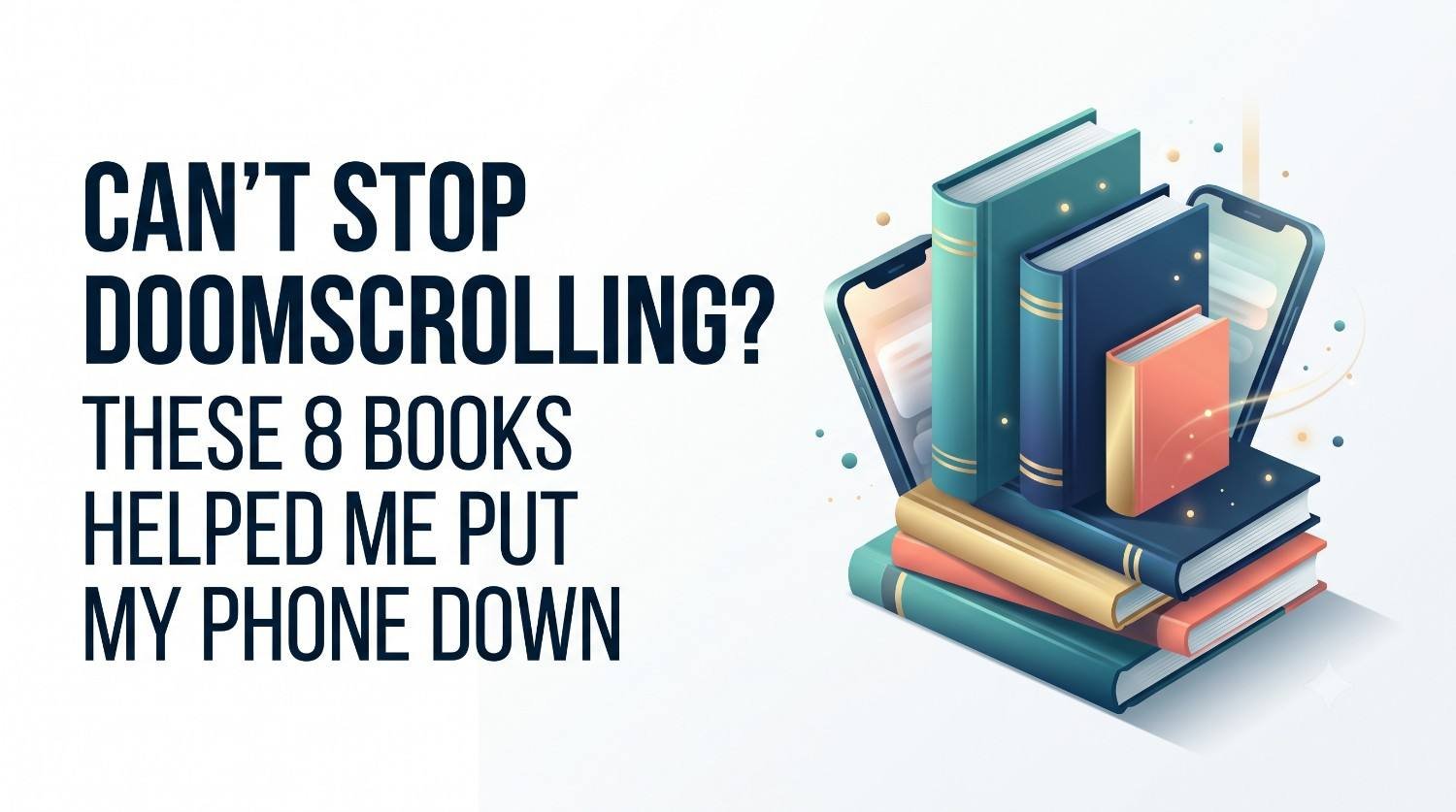
You pick up your phone for what feels like five minutes. One notification becomes a social media post, that post becomes a video, the video leads to another profile, and suddenly you have spent nearly an hour consuming information you probably will not remember tomorrow. Doomscrolling can make it surprisingly difficult to concentrate on anything that does not provide an immediate stream of fresh content. The frustrating part is that you may genuinely want to read , relax, or do something meaningful yet your hand keeps reaching for the same familiar screen, over and over again.
The good news is you do not necessarily need to make your phone vanish to change the habit. Sometimes the better strategy is to trade endless scrolling for something equally able to hold your focus, but far more satisfying. Books to stop doomscrolling can give you exactly that alternative, especially when you pick stories based on your current attention span and mood. The original Reader Life article takes a similar approach, recommending books that range from fast thrillers and emotional fiction to short story collections, with the simple idea of swapping one scroll for one chapter.
Why Doomscrolling Makes Reading Feel Difficult
Doomscrolling is kind of built for constant novelty. You scroll, you get something new, then you scroll again, and right away there’s another bit of information. But reading a book kind of asks you to do almost the exact opposite, like stay with one story, remember a few details, keep track of characters, and let the narrative unfold slowly. This gap can make reading feel hard, especially if you’ve gotten used to that quick digital stimulation. The fix isn’t always to bully yourself into a 500 page classic on day one. Instead, go for an engaging book that gives your brain a clear reason to keep turning pages, even when it starts to drag.
A useful starting point is:
- Choose a story that genuinely interests you.
- Begin with one chapter rather than an ambitious reading target.
- Keep your phone away while reading.
- Pick shorter books if your attention feels limited.
- Focus on enjoying the story rather than completing a reading goal.
1. Keep It in the Family by John Marrs
Best for readers who need a gripping page-turner
If your attention span feels kind of, like too short right now for anything slow moving, Keep It in the Family by John Marrs is a really good place to start. This novel is wired around suspense, hidden truths, and sudden revelations, so it works especially well for readers who need that immediate spark of curiosity, in order to resist the habit of checking their phone. A Reader Life review points out how the cliffhangers and those constant twists are basically the whole reason it becomes easier to stay with the story instead of going back to the screen. The basic setup revolves around a family home that hides unsettling secrets, but the bigger pull is how the details are rolled out. Every step forward pushes you to find out what comes after, and it creates that same kind of restlessness that often keeps people scrolling.
If you are looking for books instead of social media, this sort of thriller can really do the job because it gives your focus a specific direction to go.
Best for: Thriller fans, impatient readers, and anyone who wants a fast-paced story.
2. The Song of Achilles by Madeline Miller
Best for readers who want an emotional story
Sometimes the best way to escape digital noise is not by chasing some other fast paced story, but by choosing one that makes you slow down and feel something… more than “content” i guess. The Song of Achilles by Madeline Miller retells the story of Achilles and Patroclus through a deeply personal lens, and it lands differently than you might expect. The Reader Life review, notes how the novel takes those well known mythological figures and turns them into people you can actually recognize emotionally. And yeah, it’s that link, that thread, that’s what makes the book stay with you long after you finish reading.
This is also one of those books that kind of nudges you to put your phone down. Not because it’s telling you to, but because the story asks for real emotional attention, not just a quick string of sudden thrills. You might even catch yourself thinking about its characters after you close the book, and it feels very different from forgetting another social media post moments after you saw it.
Best for: Readers who enjoy mythology, historical fiction, romance, and emotional storytelling.
3. The Bell Jar by Sylvia Plath
Best for readers who want something thoughtful
Not every anti-doomscrolling book has to be fast, or even sort of fun. Sometimes the better move is a quieter tale that nudges you to slow your head down and really watch what’s there. Like, pay attention instead of just passing through.
Sylvia Plath’s The Bell Jar is a literary novel, yes, but also it’s basically a deep dive into Esther Greenwood’s private mind space. This one isn’t light reading, and it’s not casual either. What it deals with can feel emotionally heavy, and that matters. An article from Reader Life frames it pretty specifically as something for people who are already feeling soaked with the constant clatter and novelty of the internet, not as some quick fix for a “reading slump” that you can outrun in a night. The slower rhythm is kind of the point. You don’t bounce around between dozens of digital distractions , you stay with one character’s perspective and you end up spending real time considering what you’re actually reading.
Best for: Literary fiction readers and anyone looking for a reflective reading experience.
4. The Language of Thorns by Leigh Bardugo
Best for readers who cannot commit to a long novel
One of the biggest mistakes people make when trying to return to reading is picking a book that feels like homework. If your concentration is a bit rusty, a huge novel can seem intimidating even before you open it. The Language of Thorns by Leigh Bardugo gives you another way in. It’s a collection of six dark fairy tales, so you can read one story without getting stuck in a long, continuous narrative. The Reader Life article even recommends it specifically for people who want meaningful reading sessions without the pressure of finishing a whole novel.
Because of that, it’s really helpful for rebuilding your reading routine after too much screen time. You can read one story before bed, on a small break, or whenever you notice that urge to tap open yet another social media app.
Best for: Beginners, short-attention-span readers, fantasy fans, and busy readers.
5. Funny Story by Emily Henry
Best for readers who want something light
Sometimes you really do not need a serious literary experience, at least not all the time. You might just need a book that’s pleasant enough to keep you off your phone. Emily Henry’s Funny Story gives you a warm and entertaining escape from the endless online drama. In the Reader Life review it’s called funny, comforting, and character-driven, which makes it a solid pick when you want fiction that doesn’t feel emotionally exhausting. Honestly this is extra appealing because social media, kind of constantly, puts other people’s fights , their relationship problems, their opinions and all those controversies right in front of us. With fiction you can live through the messier moments on your own schedule, without having to join real lives where the stakes are personal. And if you’re trying to get back into reading with something easy, a light contemporary romance can be a smart move too, since the whole experience stays enjoyable rather than demanding .
Best for: Romance readers and anyone who wants a comforting escape.
6. We Have Always Lived in the Castle by Shirley Jackson
Best for readers who want something short and unsettling
If you want a book that’s kinda short, but still somehow manages to hold your attention the whole way through, try Shirley Jackson’s We Have Always Lived in the Castle. The novel builds tension mostly through its atmosphere , not by pushing constant action at you. In the Reader Life article it says, its compact length and that slowly tightening, unsettling mood makes it easier to read through pretty fast, like without dragging it out.
That kind of setup is really useful when you’re rebuilding concentration too. You don’t have to tell yourself you’ll be stuck reading for weeks. Instead you can sit down knowing the story is manageable, and yet still has enough mystery to keep you tuned in. If you’re one of those people who likes a short read as a sort of reset, this is a strong choice, because it proves a book doesn’t have to be enormous to leave a real lasting impression.
Best for: Gothic fiction fans, mystery readers, and people who prefer shorter novels.
7. Convenience Store Woman by Sayaka Murata
Best for readers whose minds feel cluttered
Convenience Store Woman by Sayaka Murata is short, kinda unusual, thoughtful and surprisingly funny too. It tracks Keiko, a woman who has been working in a convenience store for years, while still feeling kind of detached from what society says a normal life should look like. And honestly, thats one big reason it makes a good digital detox kind of read because it keeps returning to ordinary life. Modern online spaces constantly nudge us to compare, consume, react, and go too fast, like all the time. This novel does the opposite, in a quieter way, it just asks you to pay attention to one persons experience. Plus its pretty brief, so that whole “i have to commit to a huge project” barrier is mostly gone. You can finish it and not feel like you signed up for something major.
Best for: Readers who enjoy unconventional characters, social commentary, and concise fiction.
8. Lessons in Chemistry by Bonnie Garmus
Best for readers who want an addictive but meaningful story
Some books have this rare ability to be both entertaining, and kinda thoughtful at the same time. Lessons in Chemistry by Bonnie Garmus is one of those picks that just works.
The story tracks Elizabeth Zott, a highly intelligent and stubbornly determined woman trying to move through a society that keeps underestimating her. The Reader Life article sings its praises for the novel’s humor and heart, and for the strong central character, plus its way of giving you that “one more chapter” feeling. You know, the one that makes your phone seem way less interesting. Honestly, that makes it a solid recommendation for people who want reading that feels more fulfilling than scrolling. Instead of consuming dozens of disconnected posts, you end up giving your attention to one person’s journey, and you gradually build this real emotional closeness to the story, even without trying.
Best for: Historical fiction fans, character-driven readers, and people who enjoy humorous yet meaningful stories.
How to Choose the Right Book to Stop Doomscrolling
There isn’t really a single best book for everyone, and that’s kind of okay. What you pick should be about what you need right now while you’re reading. Like, if your mind is craving nonstop suspense then go with a thriller. If you’re feeling mentally frazzled or drained, then grab something short and cozy, something that steadies you. When you want to slow your pace down a bit, literary fiction can do that. And if long novels start to feel like too much, then choose a short story collection instead. Try looking at your book like it’s standing in for that exact, very specific reason you reach for your phone.
- Need excitement? Choose a thriller.
- Want emotional connection? Try literary or historical fiction.
- Have limited attention? Pick a short book.
- Want comfort? Choose contemporary romance.
- Want something strange? Try psychological or gothic fiction.
- Want to think deeply? Choose reflective literary fiction.
This approach makes how to stop doomscrolling feel more realistic, because you are not just removing the stimulation. You are swapping it for an experience you actually like, kind of the whole point.
Start With One Chapter , not One Hour
One of the most useful ideas from the reference article is to ease the pressure around reading. You don’t have to tell yourself you must do two hours every night. Instead, you can simply trade one scrolling session for one chapter. It works because big targets often create quiet pushback. “I need to read for an hour” can start to sound like homework, no matter what you say. “I’ll read one chapter” feels doable. Once you get pulled into the story, you may end up continuing on your own. And if you don’t, that is ok too. The goal is basically to rebuild the link between free time and reading, not to force some perfect routine.
Create a Phone-Free Reading Environment
Picking a great book is only part of the deal. If your phone sits right next to you and notifications pop up every few minutes, you’re making the contest way harder than it needs to be. Try setting up a small reading space that strips away the obvious distractions, like you’re removing the little temptations before they happen.
- Put your phone on silent or Do Not Disturb.
- Leave it across the room.
- Keep your book beside your bed or chair.
- Turn off unnecessary notifications.
- Choose a consistent reading time.
- Start with 10–20 minutes.
You are not trying to kick technology out of your life. You’re just creating a kind of pause, when your focus belongs to one thing at a time.
Why Books can feel more rewarding than endless scrolling
Social media keeps handing you fresh content, yet that doesn’t always mean it sticks. You might watch dozens of clips, and still, the next day you can’t even remember three of them . A book works in a different way. You get carried along a narrative, you keep the characters in your head, you predict what comes next, you shape your opinions and then you connect the dots slowly over time. That continuity gives your attention this calm sense of direction.
The Reader Life article makes a similar separation, basically saying that scrolling gives you stories that fade fast, while books can linger with you through their characters’ ideas, and the emotional weight. So reading instead of scrolling isn’t only about being more efficient. It’s more like choosing a form of amusement that can leave a trace behind.
A Simple 7-Day Reading Reset
If your reading habit has completely disappeared, start small. The goal is not to finish an entire book in seven days but to create a consistent alternative to automatic scrolling.
Day 1: Read one chapter before opening social media at night.
Day 2: Keep your phone outside your immediate reach while reading.
Day 3: Read for 15 minutes without checking notifications.
Day 4: Replace one scrolling session with another chapter.
Day 5: Write down one thought or idea you remember from the book.
Day 6: Read before bed instead of using your phone for entertainment.
Day 7: Review how the reading session made you feel compared with your usual scrolling session.
The purpose is not perfection. It is to prove that your attention can belong to something else.
What If You Still Want to Scroll?
You probably will. That does not mean the experiment failed , not exactly. The original article openly acknowledges that its recommended books did not magically remove doomscrolling, and the author still occasionally reached for the phone, but they found something more underlying the whole thing : a desire for stories, and plain curiosity.
That is an important distinction. You do not have to become the kind of person who never checks social media, ever. Instead, you can become someone who notices when scrolling is kind of automatic ,and then has another option sitting there, ready. Sometimes that other option is a book.
Conclusion
The best books to stop doomscrolling are not always the most intellectually impressive or critically admired titles. They are the ones that make you genuinely want to keep reading, like you’re pulled forward a little. The eight books discussed here offer multiple ways to rebuild attention , from the suspense in Keep It in the Family and the emotional thickness of The Song of Achilles to the shorter charm of The Language of Thorns and the quiet, thoughtful simplicity of Convenience Store Woman.The Reader Life original article makes an especially useful point: the goal is not to completely eliminate your phone, it’s to swap one automatic scroll for one meaningful story. Start with one chapter, put your phone a bit farther away , and choose a book that matches where you’re at right now, mood wise, rather than forcing yourself into an unrealistic reading routine. You might discover that what you were really hunting for when you opened your phone wasn’t another notification at all. It was a story worth staying with.
Frequently Asked Questions
1. What are the best books to stop doomscrolling?
Fast-paced thrillers, emotional novels, and short story collections can make it easier to replace endless scrolling with focused reading.
2. Can reading help reduce doomscrolling?
Yes. Reading gives your attention a sustained activity instead of an endless stream of constantly changing content.
3. What if I have a short attention span?
Start with short novels or story collections such as The Language of Thorns rather than forcing yourself through a long book.
4. How long should I read instead of scrolling?
Start with just one chapter or 10–20 minutes. The goal is to create a sustainable habit rather than a demanding reading target.
5. What is the easiest way to replace doomscrolling with reading?
Keep an engaging book somewhere you normally use your phone and make it easy to reach. When you instinctively reach for your phone, read one page first.